Most owners hire too early, too broad, or wait too long after they already know what's wrong. Here is how to tell which marketing work needs an expert at your stage, which is worth a one-time investment, and which you can run yourself.


Every article about hiring a marketing agency hands you the same thing. A list of signs. Your leads are down. You are out of time. Your competitor is outranking you. Check enough boxes and the conclusion is always the same, which is to hire an agency,.
That framing is wrong, and it is wrong in a way that costs you money.
Hiring help is not a yes-or-no decision triggered by symptoms. It is a question of matching the right kind of help to the right job at your specific stage. A remodeler doing $400K a year and a design-build firm doing $4M both need marketing, but almost nothing they need is the same. The first one needs a few things done right and a lot of things left alone. The second one needs systems, tracking, and a team that can run a real budget without lighting it on fire.
So the question to answer is not "is it time to hire someone." It is "which of my marketing jobs require an expert, which are worth paying for once, and which can I run myself." Answer that, and the hiring decision answers itself.
The Thought
"Should I hire an agency" treats marketing as one job. It is a dozen jobs. Some need a specialist, some are worth a one-time investment, some you keep in-house for free. The owners who grow profitably are the ones who can tell the difference.

If you are a remodeler or builder in your first few years, doing under roughly $1M and getting most of your work from referrals and repeat clients, you are in the Foundation stage. Your marketing problem is not sophistication. It is existence. You need to show up when someone Googles your name or your trade in your town, and you need to not look amateur when they do.
At this stage, a full-service agency on retainer is usually the wrong spend. You do not have the lead volume to justify managed advertising, and you do not have the data for anyone to optimize against. What you do have is a set of foundational assets that need to exist and need to be right, and this is where the competitor advice fails worst. The listicles treat the early stage as "not ready to buy yet." The truth is the opposite. The early stage is exactly when a one-time investment in the right assets pays off for the longest.
Pay once, and pay well, for the things that last. A brand and visual identity that makes a $60K kitchen look like a $60K kitchen. A website that loads fast and shows real project photography instead of stock images. Photography direction itself, because nothing else you do in marketing for the next five years works without good images of your own work. These are not retainer items. They are capital investments in the business, the same way a wrapped truck or a clean showroom is, and they keep returning value long after you pay for them.
The day-to-day, you run yourself. Claiming and filling out your Google Business Profile, asking happy clients for reviews, posting your own project photos. None of that needs a specialist. Spend your money on the assets with a long life, and keep the recurring work in your own hands until the math changes.
The Foundation Rule
Before you have lead volume and tracking, there is nothing for an agency to manage month to month. Put your money into assets that last for years, which means brand, website, and photography. Run the rest yourself.
This is where it gets expensive if you get it wrong. Once you are past referrals only and actively trying to generate leads, call it $1M to $2M with budget to invest and a real desire to grow, you hit the stage where most bad agency relationships start. You know you need to do more. You do not know exactly what. And there are a hundred companies happy to sell you a package.
Here is the framework that keeps you from overpaying. Every marketing task at this stage falls into one of three buckets. We call it the Build / Borrow / Buy triage.
Build is what you keep in-house, because it needs your voice, your projects, and your knowledge of your market.
Borrow is what you hand to a tool, because it is templated or automated well enough now that a tool plus ten minutes beats paying for it.
Buy is what you hire an expert for, because getting it wrong costs real money and the skill ceiling is genuinely high.

I have major opinions on the stuff that I work with, mostly because I’ve seen it all in the last 12 years. People talk themselves into running their own search campaigns to save the management fee, and I get it. Its such a high value item. If you can afford to do it right, paying for clicks you and not structuring costs well, you will lose more in marketing budget than the fee would have.
If you want a paid channel early, LSAs are the better entry point. They are trust-based, lower-skill to operate, and harder to waste money on than a search campaign. Everything else in the Buy column, I’d recommend at least speaking to a professional about. Everything above it, try and avoid a monthly retainer or a long term contract.
Build / Borrow / Buy
The work that needs your voice, you Build. The work a tool now handles, you Borrow. The work where mistakes cost real money, which is ad structure, tracking, and conversion, you Buy. Most overspending comes from buying what you should have borrowed, and most waste comes from trying to build what you should have bought.
Once you are at $2M or more in revenue, running real ad spend, and trying to grow predictably instead of riding the referral roller coaster, the calculation flips. Now an agency is not a luxury or a leak. It is the thing standing between you and growth at scale where a wasted marketing budget will hurt the most.
At this stage you are not hiring someone to write GBP posts. You are hiring someone to own the system that turns ad spend into booked projects and proves the math. That means Google Ads built by service line, conversion tracking that ties a lead back to the keyword that produced it, landing pages that convert at 15 to 25 percent instead of 3 to 5, and a brand layer that makes the right homeowner choose you before the first call. These pieces only work as a connected system. Run the ads without the brand and you pay for clicks that do not convert. Build the brand without the tracking and you cannot prove anything.
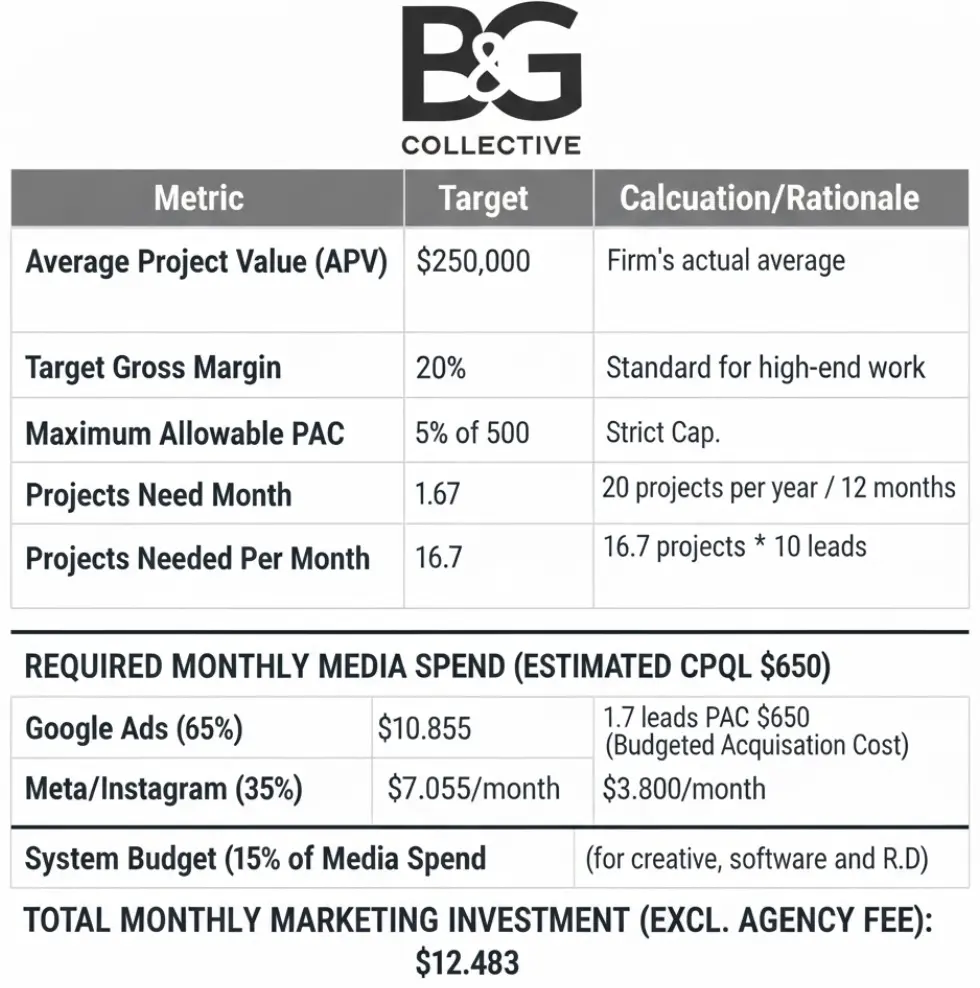
The metric that matters here is cost per booked project, not cost per lead. The point of buying expertise at Scale is to connect spend to signed contracts, so you know that a $250 lead closing at 30 percent into a $65,000 kitchen is cheap, and a $40 marketplace lead closing at 6 percent is not. If you want the full breakdown of how that math runs against pay-per-lead platforms, our guide to building a remodeling lead system that replaces pay-per-lead marketplaces walks through it.
Scale Economics
At real ad spend, badly run campaigns cost more than the team that would fix them. The fee is not the expense. The wasted spend is. Buy the system that proves cost per booked project, not the one that reports clicks.
The natural next thought at Scale is to bring it in-house. Hire your own marketing person, stop paying an agency, own the whole thing. The better way to think about it is not in-house versus agency. It is understanding that a great marketing manager and a paid-media specialist are two different jobs, and the strongest setups use both.
A strong in-house marketing manager is worth their weight. Their defining skill is breadth and orchestration. They hold the whole picture, which means brand, website, content, email, the sales process, and paid all pointed in the same direction and playing well together. They make sure the campaign matches the brand, the landing page matches the ad, and nothing drifts out of sync. That is hard, and most owners underrate how valuable it is until they try to coordinate five channels themselves.
Paid media is a different discipline. It rewards depth over breadth, and the depth comes from reps, which means running many accounts across many markets and learning what burns budget and what books projects. The people who get genuinely good at it tend to do it full time, often agency-side, because that is where the volume of accounts and the competitive pay are. A single remodeling company, even a healthy one, rarely generates enough paid work to keep a true specialist sharp or to justify a specialist's salary on its own.
So the question is not which one to hire. It is how to combine them. The strongest setup at Scale is often a great in-house manager who owns the whole marketing picture and partners with an agency for the specialist paid work. The manager keeps everything aligned and accountable. The agency brings the depth on ad structure, tracking, and conversion that is hard to build or retain inside one company. They are not competing for the same seat. They are covering different ground, and together they cover all of it.
Breadth and Depth
A great in-house manager wins on breadth, which means keeping every channel aligned and pulling the same direction. A paid specialist wins on depth, which comes from running many accounts. The strongest setup at scale is not one or the other. It is a manager who owns the picture and an agency partner who owns the specialist work.
Here is the part no listicle mentions, and it is the one that actually costs owners the most. The damage is rarely in picking the wrong help. It is in moving slowly after you already know what is wrong.
You feel the leads slipping. You notice the website looks dated next to the firm winning the jobs you want. You realize the spend is not producing booked projects. You have, in other words, named the problem. And then a quarter goes by. Then another. You are getting around to it. Meanwhile the leak runs the whole time, and every month it stays open is revenue you do not get back, because cash flow does not wait for you to feel ready.
Speed is not recklessness here. Naming a problem and then sitting on it is the expensive choice dressed up as the cautious one. If the issue is small and you can fix it yourself, fix it this week. If it is a one-time asset like brand or a website, commission it now rather than after another slow season. If it is specialist work, start vetting the agency now instead of posting a role you will spend six months failing to fill while the spend leaks. The owners who grow are not the ones who deliberate longest. They are the ones who move once the problem has a name.
The honest answer to "when should I hire a marketing agency" is this. Invest early in the assets that last. Triage hard through the Traction stage so you buy only the work that genuinely needs an expert. Bring in a real system once you are spending enough that bad execution costs more than good help. And once you have named a problem, act on it before it drains another quarter.
If you are running real ad spend and you are not sure whether your campaigns are built to book projects or just to generate clicks, that is the conversation worth having. We build the Google Ads, tracking, and brand systems that make spend convert for remodelers and design-build firms doing $2M+ in revenue, and we will tell you honestly which parts you should keep running yourself.
If you want to see what the next stage looks like first, start with how much remodelers should actually budget for Google Ads, or what a properly structured remodeler campaign looks like under the hood.
Isn't hiring an agency just admitting I can't do my own marketing?
No. It is deciding where your time and money produce the most return. A remodeler doing $3M should not be hand-building Google Ads campaigns any more than they should be framing every house themselves. The skill exists, but your time is worth more pointed at the business. The goal is not to outsource everything. It is to outsource the work where an expert produces a result you cannot, invest once in the assets that last, and keep the work where your voice and judgment matter.
Should I just run my own Google Ads to save the fee?
If you can afford to do it right, no. Search campaigns punish whoever runs them without the skill, and the wasted spend usually exceeds the management fee you were trying to avoid. If you want a paid channel early, Local Services Ads are a better entry point, since they are trust-based and far harder to waste money on. Save real search advertising for when you can bring in someone who does it for a living.
Wouldn't hiring my own marketing person in-house mean I don't need an agency?
Not necessarily, because they tend to be good at different things. A strong in-house marketing manager wins on breadth, keeping brand, web, content, and paid all aligned and pulling the same direction, which is genuinely valuable and hard to do well. Paid media is a depth discipline where the skill comes from running many accounts, which is tough for a single company to build or justify in one seat. The strongest setup at scale is often both: an in-house manager who owns the whole picture, partnered with an agency that owns the specialist paid work. They cover different ground rather than competing for the same one.
How fast do I really need to act once I spot a problem?
Faster than you think. The expensive mistake is rarely choosing the wrong fix. It is naming a problem and then letting a quarter or two pass before you address it, while the leak drains cash flow the entire time. If it is a quick fix, handle it this week. If it is a one-time asset or specialist work, start now rather than after another slow season.
Turn tactics into traction with a strategy built to perform, no guesswork, no fluff, just results.