the solution

How High-End Remodelers and Builders Can Budget for Predictable Lead Flow

The Predictable Advertising Budget for Custom Home Builders and High-End Remodelers

When I start working with a new custom builder or a high-end remodeling firm, the first thing I notice about their marketing isn't the creative or the platform; it’s the profound lack of connection between their ad spend and their business goals. Most firms treat their digital advertising budget like an arbitrary cap or a necessary expense that gets slashed the moment the pipeline looks full. That approach guarantees one outcome: the feast-or-famine cycle that keeps many serious companies stuck in a reactionary mode.

I reject the notion that marketing is an expense. For a professional builder or remodeler, it is an investment in future capacity, and it must be managed with the same rigor as material costs or labor projections. My focus, always, is on predictability and ROI. If you can’t tell me exactly what it costs to acquire a qualified lead and what the expected project value is, you don’t have a marketing system—you have a marketing lottery.

To build a predictable system, we have to start by flipping the traditional budgeting model. Instead of asking, “How much can I spend?” we must ask, “What capacity do I need to fill, and what is the maximum I can pay to fill it?”

The Critical Metrics: "Back-Casting" the Budget

I operate on three non-negotiable metrics that dictate the entire ad budget structure:

  1. Ideal Project Acquisition Cost (PAC): This is the total cost—advertising, agency fees, internal sales time—to close one ideal project. For a high-end remodeler with an average project value of $250,000 and a net profit margin target of 15%, a PAC of $10,000 might be appropriate, representing 4% of the project value.
  2. Required Lead Volume: How many qualified leads does your sales process need per month to hit your project acquisition goal? If your closing rate is 10% (one in ten qualified leads becomes a client), and you need two projects per month, you need 20 qualified leads.
  3. Target Cost Per Qualified Lead (CPQL): This is the maximum you can pay for a truly qualified lead while staying profitable.

The entire system starts with your capacity and gross margin. A custom builder I worked with in the Pacific Northwest was aiming for eight projects a year at an average value of $1.8 million. They maintained a strict 22% gross margin. We calculated that their maximum sustainable PAC was $36,000 per project. Knowing their ideal client profile, we built a CPQL target of $350. Anything over that threatened their margin targets.

Phase 1: Budgeting for the Lead Generation Machine

The core digital advertising budget must be laser-focused on acquiring the initial qualified lead. This is where most of the money goes, and it is almost entirely split between search intent (Google Ads) and awareness/nurturing (Meta/Instagram).

1. Investment in Intent: Google Ads

For serious builders and remodelers, Google Ads is not optional; it is the infrastructure for capturing existing, high-intent demand. When someone types in “custom home builder [city name]” or “kitchen remodel cost calculator [zip code],” they are signaling an immediate need. This traffic converts, but it is also highly competitive.

My budget allocation here is simple: Maximum exposure for high-intent keywords. I advise my clients to allocate 60-70% of their total ad budget to Google Ads, specifically:

  • Branded Search: Protect your name. It’s cheap, and the ROI is virtually guaranteed.
  • High-Intent Non-Branded: Target the core "builder," "remodeler," "contractor," and "design-build" terms in your service area. This is expensive, but it's where the immediate revenue is.
  • Long-Tail/Informational: Capture prospects earlier in the journey with content-driven ads, like those targeting “cost to build a custom home” or “timeline for major home renovation.”

I have seen high-end custom home builders pay anywhere from $15 to $35 per click for core non-branded terms in competitive markets. If your landing page and offer are dialed in, you might convert clicks to qualified leads at a rate of 5-8%. This means a CPQL of $187 to $700, which aligns with the PAC we discussed earlier. The key is consistent, aggressive bidding to maintain rank, even when you feel like you have enough leads. The moment you pull back, a competitor steps in and steals your momentum.

2. Investment in Awareness and Nurturing: Meta/Instagram Ads

I use Meta and Instagram for two purposes: filling the top of the funnel with awareness and nurturing the leads captured by other means. I allocate the remaining 30-40% of the budget here.

  • Awareness Campaigns (50-60% of Meta Budget): These target geographically focused, high-net-worth audiences. We use stunning project photography and video, focusing on the quality of the craft and the lifestyle, not just the price. The goal is to generate low-cost, high-quality traffic to lead magnets like e-books, project galleries, or downloadable guides. This builds our retargeting pool.
  • Retargeting and Nurturing (40-50% of Meta Budget): This is arguably the highest ROI use of social media ad spend. We target everyone who visited the website, downloaded a guide, or watched a significant portion of a video, but who hasn't submitted a project inquiry. The messaging is direct, focusing on social proof (testimonials, case studies) and urgency (project calendars filling up).

A serious high-end firm shouldn't be relying on low-cost Facebook lead forms to drive the bulk of their revenue. They should be using the platform to generate high-quality web traffic that converts on the site, or to nurture and re-engage prospects who are already familiar with the brand. This structured approach respects the fact that the buyer journey for a custom home or major remodel can span 12 to 24 months [1].

Phase 2: Budgeting for the System, Not Just the Click

A common failure point is budgeting only for the click or the impression. A professional marketing system requires three layers of consistent investment beyond the pure media spend:

A. Creative and Content Velocity

The performance of an ad campaign is inextricably linked to the quality and volume of the underlying creative. When I see performance drop, it is usually because the firm is running the same five images they launched with six months ago. You must have a rolling budget for professional photography, drone video, and the creation of new lead-generating assets (guides, calculators, project studies). The cost of production for new, high-quality creatives should be factored into your total marketing overhead. This is the fuel that prevents ad fatigue.

B. The Retargeting Buffer

Never turn off your retargeting campaigns. Even if you pause your cold lead generation, keep a minimum budget running across Google and Meta to ensure that anyone who showed interest in the last 90-180 days is still seeing your brand. This acts as a pipeline pressure valve. One study found that, on average, it takes 7.6 online touches before a home buyer/remodeler takes action [2]. That means if you stop touching them after three, you're donating your budget to a competitor.

C. The "Test & Scale" Pool

I advise clients to allocate a small, fixed percentage (5-10%) of their total monthly budget to pure testing. This could be exploring a new platform (like YouTube or Pinterest for visual inspiration), A/B testing a radically different landing page, or experimenting with a new offer structure (e.g., a fixed-price design concept package instead of a free consultation). This budget is not expected to be immediately profitable; it is the R&D component of your marketing. Without it, your system will stagnate.

The Predictive Budget Model in Practice

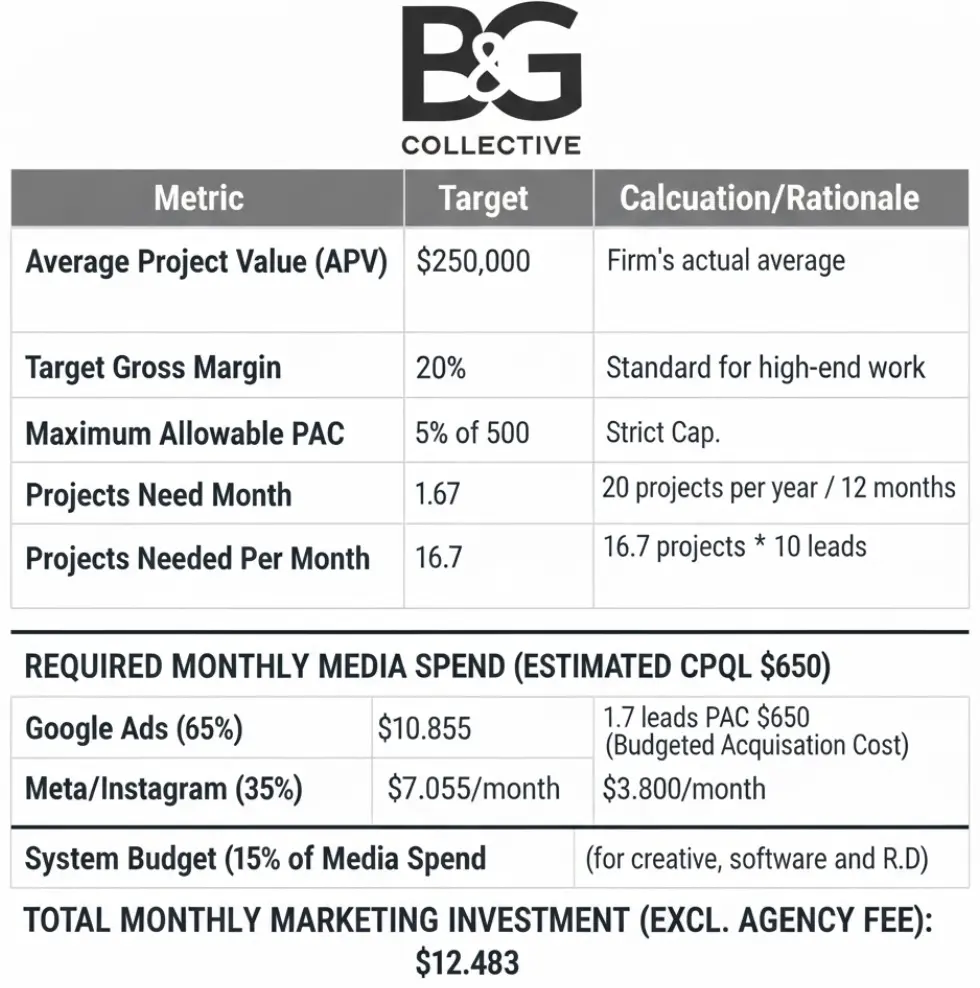
Let’s apply this to a remodeler targeting $5 million in annual revenue, needing 20 ideal projects per year (1.67 per month).

Based on this calculation, the firm must consistently invest a minimum of $10,855 in media spend per month to hit its lead flow target.

We would then break down the $10,855:

  • Google Ads (65%): $7,055/month
  • Meta/Instagram (35%): $3,800/month
  • System Budget (15% of Media Spend): $1,628/month (for creative, software, and R&D)
  • Total Monthly Marketing Investment (Excl. Agency Fee): $12,483

This budget isn't a suggestion; it's a non-negotiable requirement for the firm to fill its capacity and maintain the target margin. By basing the budget on the required output and the allowable acquisition cost, we move from chaos to a predictable, data-driven system.

My advice is direct: if you cannot justify an advertising investment using a back-casted model like this, you shouldn't be spending the money. Your marketing must be a predictable, systematized investment in your future capacity. Nothing less is professional.

FAQ Section

How do I determine my Ideal Project Acquisition Cost (PAC)?

Your PAC is determined by taking a percentage of your average project value (APV) that you are willing to spend to acquire a client. For high-end builders and remodelers, I typically advise keeping the total PAC (including ad spend, overhead, and agency fees) between 3% and 7% of the APV to protect net profit margins.

Should I cut my ad budget when my pipeline is full?

Absolutely not. Cutting your budget when the pipeline is full guarantees a lull 6-12 months later, which perpetuates the feast-or-famine cycle. Your budget should be maintained to ensure consistent lead flow and predictable capacity filling in the future. Treat the excess leads as a competitive advantage that allows you to be more selective with the projects you take.

How much should I spend on retargeting versus cold traffic?

For most professional firms, the retargeting budget should be a fixed, non-negotiable portion of your total ad spend, usually 10% to 15%. This budget is dedicated to nurturing prospects who already know your brand and is often the highest-ROI portion of the campaign, converting familiar leads at a much lower cost.

Is it better to focus my budget on Google Ads or Meta/Instagram?

For high-end builders and remodelers, a performance-driven budget should allocate more to Google Ads (typically 60-70%). This is because Google captures existing intent (people actively searching for your service), which generates qualified leads faster. Meta/Instagram is critical for awareness, brand building, and low-cost retargeting, but it is generally a longer-term nurture play.

What is a realistic Cost Per Qualified Lead (CPQL) for a custom builder?

In competitive, affluent markets, a realistic CPQL for a truly qualified, high-value custom home or major renovation lead can range from $500 to over $1,200. The key is that this cost must be offset by the high project value. If your APV is $1.5 million, paying $1,000 for a qualified lead is highly profitable, provided your closing rate is strong.

How often should I review and adjust my ad budget?

Your budget should be reviewed monthly based on lead volume, CPQL, and the quality of the appointments generated. However, significant adjustments should only occur quarterly, or when your business capacity goals fundamentally change. Consistent spending is key to stable performance and reliable data.

Can I rely on SEO instead of paying for Google Ads?

SEO is essential for long-term, organic growth, but it is too slow and unpredictable to be the primary engine for capacity filling. Google Ads provides immediate, precise control over your lead flow and is necessary to capture existing demand while your SEO strategy matures. Professional firms use both, with advertising ensuring predictability.

Footnotes

[1] https://www.nahb.org/news-and-events/in-the-news/2023/11/remodeling-market-outlook-growth-expected-to-slow-but-remain-positive-in-2024

[2] https://www.pewresearch.org/internet/2021/04/07/digital-readiness-around-the-world/

start now

Let’s create your next win.

Let’s talk about results like these for your team.
get started
get started

services

001

Lead Gen Systems

Performance-driven campaigns that attract high-intent leads and keep your pipeline full.

002

website & Creative

Clean, conversion-focused design that builds trust and turns interest into action.

003

Brand Identity & Messaging

Strategic branding that builds credibility, aligns your voice, and supports every channel.

004

Search & Content Strategy

SEO and content built to boost visibility, drive organic traffic, and support long-term growth.

005

Growth Strategy & Consulting

Actionable, insight-led marketing plans that prioritize clarity, ROI, and momentum.

start today

Done Reading? Let’s Start Building.

Turn tactics into traction with a strategy built to perform, no guesswork, no fluff, just results.