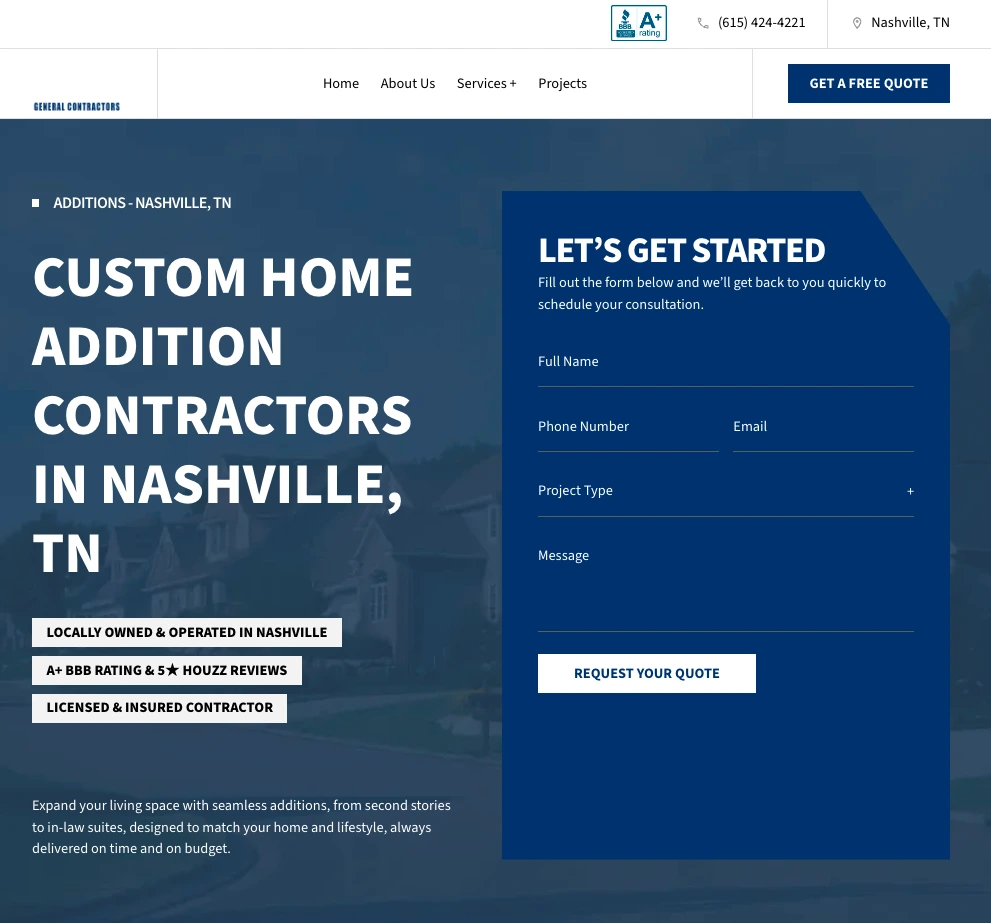
3. Clear, Singular Call-to-Action (CTA): The Conversion Funnel
The page has one goal: conversion. The entire layout must lead the eye toward the Call-to-Action (CTA). This is where most remodelers fail by being vague.
- Specific CTAs: Use clear, action-oriented language that highlights the benefit to the client, not just the action you want them to take. Use "Get My Free Estimate," "Schedule Your Design Consultation," or "See Project Pricing," not the generic "Submit" or "Contact Us".
- Form Simplicity: Only ask for the essential information you need for the first sales contact: Name, Phone, Email, and a brief description of the project. A long form creates friction and will hemorrhage leads. Mobile-friendliness is non-negotiable; forms must be easy to fill out on a small screen.
- Multiple Placement: The CTA button should be visually prominent (using contrasting colors) and repeated strategically as the user scrolls down the page. Research shows less than 22% of people scroll to the bottom of a page, so your core elements must be high up.
Even a small increase in your conversion rate can have massive revenue implications. If you are getting 1,000 visitors a month, moving from a 6% median rate to a 14% top-performer rate (the benchmark for professional services) means you capture 80 more leads per month. That is the difference between surviving and scaling.
The ad gets the click. The page gets the job. Don't let your conversion engine be the weakest link in your system.
FAQ Section
What is considered a "good" conversion rate for a remodeler landing page?
For professional service pages (which includes remodeling), the median conversion rate is 6.1%. However, a truly "good" rate—one that puts you in the top 25%—is 14.1% or higher. Targeting a 15-20% rate is a realistic goal for high-intent Google Search traffic.
How fast does my remodeler landing page need to load?
Speed is crucial. Pages that load in under 1 second see conversion rates as high as 31.79%. Conversion rates drop significantly if the page takes longer than 2 seconds. Mobile optimization is essential for visual content and quick load times.
Should I use a video on my landing page?
Yes. Videos are a powerful way to build trust quickly and showcase your craftsmanship. A good video is short, attention-grabbing, and helps build rapport by letting the homeowner see who is "behind the wheel".
Should my landing page be short or long?
It depends on the complexity and cost of the project. Simple goals (like a free estimate) can be accomplished with a shorter page. However, for high-ticket custom remodels, the page should include enough content to address common homeowner questions, emphasize benefits over features, and showcase social proof to eliminate anxiety.
Where should the Call-to-Action (CTA) be placed?
The CTA should be prominently displayed "above the fold" (visible without scrolling) and repeated throughout the page, especially for longer layouts. Crucially, make sure your phone number is clickable for mobile users.
Footnotes
[1] https://unbounce.com/landing-pages/whats-a-good-conversion-rate/[
2] https://contractingempire.com/contractor-landing-pages/
[3] https://www.nutshell.com/marketing/resources/high-conversion-landing-pages[
4] https://www.bgcollective.com/solutions-lab/google-ads-for-remodelers-wins
[5] https://kitchenremodelingseo.com/google-ad-mistakes/
.webp)