If you tried Facebook ads and got a pile of comments, a few tire-kickers, and no booked projects, the platform did not fail you. The strategy did. Here is how remodelers should actually use Meta in 2026, and the order of operations that makes it pay.


Mention Facebook ads to a room of remodelers and you will hear the same story. Someone put a few thousand dollars into a campaign, got a flood of likes and comments, fielded a handful of calls from people who wanted a deal, and booked nothing. They walked away certain that Facebook does not work for remodeling.
Here is what actually happened. They used Facebook the way you use Google, and the two platforms could not be more different.
On Google, the homeowner is hunting. They type "kitchen remodel contractor near me" because they have already decided to act, and your ad meets them at the moment of intent. On Facebook and Instagram, nobody is searching for you. They are scrolling through photos of their nephew and a recipe video, and your ad interrupts that scroll. The only thing that earns a stop is the work itself, and even then, the person who stops is rarely ready to hire today. They are interested. They are not in motion.
That difference is not a weakness. It is the entire reason Meta has a job to do. Google captures the homeowners who are ready right now. Meta works on everyone else, the much larger group who will be ready in a few weeks or a few months, by staying in front of them until the timing turns. Run Meta expecting Google's results and you will be disappointed every time. Run it for what it is actually good at, in the right order, and it becomes one of the most valuable layers in your marketing.
Attention Versus Intent
Google captures intent. Facebook earns attention. A remodeler who expects Facebook to produce ready-to-hire leads on day one is asking a long-decision platform to behave like a search engine. The fix is not a better ad. It is using each platform for the job it actually does.
Before we get to campaigns, it helps to see how a homeowner really moves toward hiring you, because almost nobody does it in a straight line anymore.
A homeowner sees a stunning kitchen transformation on Instagram and saves it. A week later they Google your company name to see if you are legitimate. They read your reviews on your Google Business Profile. They ask an AI assistant what a kitchen remodel should cost in their area and what questions to ask a contractor. They land back on your website, poke around your portfolio, and leave again without calling. Three weeks later your remarketing ad shows up while they are scrolling, reminding them you exist right as the kitchen conversation at home is heating up. Then they call.
That is not a funnel. It is a loop, and it runs across Facebook, Instagram, Google, your Google Business Profile, and increasingly AI tools, in no fixed order. No single channel owns the decision. Each one does part of the work.
Inside that loop, Facebook and Instagram do something the other channels cannot. They are where visual discovery and trust-building happen. They are where a homeowner first falls for your work and then keeps seeing it often enough to believe you are the real thing. Meta's job is to seed the interest and reinforce it, to be the visual proof that shows up before the search and during the long stretch of deliberation. That is why running Facebook in isolation, disconnected from your Google presence and your brand, leaves results on the table. It is one instrument in a system, and it plays its part best when the rest of the system is also in tune.
The Decision Is a Loop, Not a Funnel
Homeowners bounce between Instagram, Google, reviews, AI tools, and your site for weeks before they call. Meta is where the visual trust gets built and reinforced. It rarely closes the deal alone, and it was never supposed to.

If you do only one thing on Meta, do this. Remarketing is showing your ads to people who already visited your website, engaged with your social posts, or are on a list you have built. They know who you are. You are not introducing yourself to a stranger, you are staying in front of someone who already raised their hand.
This matters more for remodeling than for almost any other business because of how long the decision takes. A remodel is not a pair of shoes. Nobody scrolls past a retargeting ad and impulse-buys a $60,000 kitchen the way they grab sneakers on a whim. The decision stretches across weeks or months. It involves a spouse, a budget conversation, a financing question, a season of saving up or waiting for the kids' schedule to clear. During that entire stretch, most homeowners who visited your site once will simply forget you if nothing brings you back.
A standing remarketing campaign is what brings you back. It keeps your completed projects on their screen across the whole deliberation, so when the conversation at the kitchen table finally turns serious, you are the name they remember. You are not paying to convince a stranger. You are paying to stay present with someone already interested, which is why remarketing is the most efficient spend on the platform.
Across the accounts we manage, an East Coast design-build remodeling firm runs Meta remarketing at roughly $90 per lead, mostly on whole-home and general remodeling work. That is a strong number for the platform, and it is achievable precisely because the audience is warm. These are not cold strangers. They are people who already know the firm and needed a reason to come back.
For builders and remodelers working longer cycles, the case is even stronger. A custom home builder may sit in a homeowner's decision for three to twelve months. There is no version of that timeline where you can afford to disappear after one website visit. Remarketing is how you stay in the running across a decision that outlasts most marketing campaigns.
A Remodel Is Not a Pair of Shoes
The decision runs weeks to months and involves more than one person. A standing remarketing campaign keeps your work on screen across that entire stretch, so you are the name they remember when the conversation gets serious. For remodelers, this is the one Meta play that is close to non-negotiable.
Prospecting is using Meta to reach cold audiences who have never heard of you, based on their location, age, homeownership, interests, and behavior. It can work for remodelers. But it is a later-stage move, and the order matters.
Here is the gate to check before you spend a dollar on Meta prospecting. Is your Google presence fully established, running consistent budget, with healthy impression share? Impression share is the percentage of available searches where your ad actually shows up. If yours is low, you are leaving ready-to-hire homeowners on the table every day, people actively searching for exactly what you do. Every dollar belongs in Google capturing that existing demand before it goes to Meta trying to create new demand. Paying to interest cold strangers on Facebook while ignoring homeowners already raising their hands on Google is spending money in the wrong order.
Once Google is handling the existing demand and you still have budget to grow, Meta prospecting becomes a legitimate way to expand the top of your funnel and feed more people into that remarketing loop. The cost reflects the difficulty. That same East Coast design-build firm sees prospecting leads land between $250 and $400 each, depending on the project type, compared to roughly $90 on remarketing. The cold audience is more expensive because you are doing the harder work of earning attention from people who did not come looking for you.
The Budget Gate
If your Google impression share is leaving demand on the table, every dollar belongs in Google before Meta prospecting. Capture the homeowners already searching before you pay to interest the ones who are not. Prospecting is what you do after you have earned it, not instead of the work that comes first.
There is a mechanical reason prospecting is harder, and it comes down to how Meta's system actually finds your buyers. It is worth understanding in plain terms, because it explains nearly everything about running the platform well.
Google finds buyers by intent. Someone searches, and the keyword tells Google exactly what they want. Meta has no search to read. Instead, its system finds buyers by testing. It shows your ad to a slice of people, watches who stops, who watches, who clicks, who converts, and then uses that signal to go find more people like them. The way it learns is through creative. Every photo, every video, every ad variation is a test, and the algorithm needs several of them to figure out who responds to what. Feed it one tired image and it has almost nothing to learn from. Feed it a range of strong creative and it can find the pattern that leads to your buyers.
This is why creative is not a detail on Meta. It is the engine. And good creative costs real money and real time. Video, which consistently outperforms static images on Facebook and Instagram, has to be produced, which means someone capturing footage on your job sites, editing it well, and refreshing it as it wears out. That is a budget line and it is time from your team, getting on site, letting a camera roll, showing the before and the after. There is no way around it. The remodelers who win on Meta are the ones who treat creative as a standing investment, not a one-time asset.
This also explains the order of operations one more time. Remarketing needs less creative volume because the audience already trusts you and needs only a nudge. Prospecting needs a real creative engine because cold audiences give the algorithm nothing to work with unless you hand it strong, varied material to test. The creative cost is a big part of why prospecting is a later, budget-permitting move.
Creative Is the Engine, Not the Decoration
Meta finds your buyers by testing creative and learning who responds. Weak or repetitive creative gives the algorithm nothing to learn from. Strong, varied creative is what makes the platform work, and producing it is a real cost in both money and your team's time on site.

This leads to the most useful thing you can do when an agency pitches you Facebook ad management. Ask to see samples of the creative they actually produce.
Agencies like selling Facebook ad management because it is recurring revenue, and plenty of them are genuinely good at it. But because creative is the hard, expensive part, it is also the corner most often cut. Some shops put all their effort into targeting and audience setup, then run thin, generic, or low-effort creative that gives the algorithm nothing to work with. Increasingly, some lean on quick AI-generated filler with no craft behind it. Targeting cannot save weak creative, because on Meta the creative is what the system learns from in the first place.
So make them prove it. Ask to see real video and real ad creative they have produced for other contractors or remodelers. Look for actual production quality, real editing, work that would look at home next to a strong brand. The point is not that AI tools are bad, since AI-assisted work can be part of a sharp process. The point is craft. If what they show you is template filler or obviously auto-generated junk, that tells you the campaigns will underperform no matter how dialed the targeting is. Strong creative is the single clearest signal that a team can actually make Meta work.
Getting the click is half the job. What the homeowner lands on decides whether that click becomes a lead worth having, and on Meta this matters more than on Google because the traffic is colder. A homeowner who clicked your retargeting ad is interested but still half-distracted, one tap away from going back to scrolling. The page has to do real work, fast.
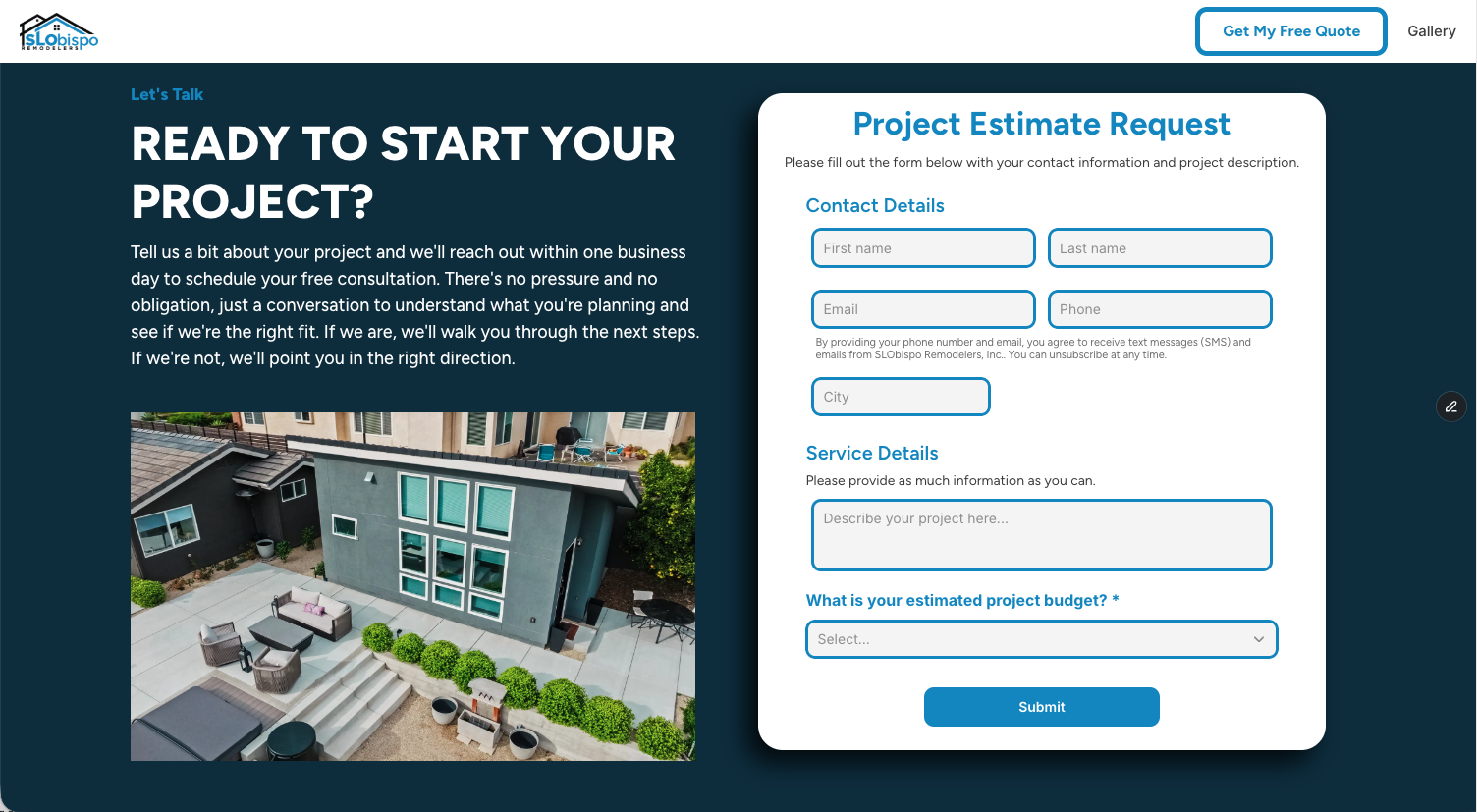
Send Meta traffic to a real landing page, not a lead form. Native Facebook lead forms are tempting because they lower friction and drop your cost per lead. They are also almost never the right call for high-value remodeling projects. The problem is what that low friction produces. Someone who taps a pre-filled form between two videos never left Facebook, never saw your portfolio, never felt your brand. You get cheap volume and soft intent. Compare that to a homeowner who clicked through, saw your completed kitchens at the scope you want, read your process, and chose to reach out anyway. That person is a fundamentally better prospect. For the projects worth booking, the friction of a real landing page is a feature, because it qualifies the homeowner before they ever reach your inbox.
Give the ad a reason to act, matched to how ready the audience is. Cold and warm audiences need different offers. A standing remarketing audience that already knows you might just need a nudge toward a consultation. A cold prospecting audience needs something lower-commitment to earn the click. Think of offers on a ladder by how much they ask of the homeowner:
Matching the offer to the audience's readiness is the skill. Put a "book a consultation" offer in front of a cold audience and most scroll past. Put a useful cost guide in front of them and you capture people months before a competitor ever hears from them.
Friction as a Feature
Native lead forms produce cheap, soft leads because the homeowner never saw your work. For high-value projects, drive Meta traffic to a real landing page with an offer matched to the audience's readiness. The friction is not a bug. It is what separates a real prospect from a tap between two reels.
There is one more job Meta does well that almost nobody talks about, and it resolves an apparent contradiction in what you just read. A moment ago I said lead forms are almost never the answer. Here is the exception, and the rule that makes sense of both.
A large share of the homeowners Meta puts in front of you are interested but nowhere near ready. They like your work, they are starting to think about a project, but they are months from a decision. You do not want to call these people tomorrow and you do not want to treat them like ready buyers. You want to capture them, get them onto a list, and stay in front of them with useful content until the timing turns. This is the research-stage audience, and Meta is one of the best places to build it.
For this specific job, a low-friction capture is appropriate, because here you actually want volume and you are going to nurture these people over months, not call them this week. A "[City] Remodel Cost Guide" download that collects an email is a perfectly good way to build this list. The determining factor was never the form mechanism. It was the intent you are capturing. High-intent project inquiries earn the real landing page, because there you want qualified intent and the page does the qualifying. Low-intent, research-stage list-building can use the lighter capture, because there you want reach and the nurture happens later.
Match the friction to the intent. That single rule tells you when to send traffic to a real page and when a simple capture is fine, and it keeps you from either chasing cheap leads or scaring off researchers who were never going to call today anyway.
Putting it together, here is the structure we run in 2026, explained simply. It has two parts that do two different jobs.
Test and feeder campaigns. This is your lab. You run a controlled set of creative and audiences on a modest budget with one purpose, to find out what actually works. Which video stops the scroll. Which offer earns the click. Which audience responds. Most of what you test will be average, and that is the point. The lab exists to surface the few winners.
Separate scaling campaigns. Once a piece of creative or an audience proves itself in the lab, you promote it into its own campaign with real budget behind it. You keep these separate from the testing on purpose. If you pour budget into the same campaign where you are still experimenting, you destabilize what is already working. By isolating the proven winners, you scale them cleanly while the lab keeps running in the background, feeding up the next winner.
That is the whole approach. A small lab to find what works, a separate engine to pour budget into the proven winners. It keeps your spend pointed at what is actually converting instead of getting muddied by constant experimentation, and it is a meaningful part of why some remodelers' Meta campaigns compound while others stall.
A Lab and an Engine
Run a small testing campaign to find the creative and audiences that work, then promote the winners into separate, well-funded scaling campaigns. Keep testing and scaling apart so experimentation never destabilizes what is already converting.
Step back and the whole thing fits together. Google captures the homeowners ready to hire right now. Your website and brand convert them. Meta remarketing keeps you in front of everyone who is interested but still deciding, across the long stretch Google cannot reach. Meta prospecting, once you have earned it, widens the top of the funnel and feeds more people into that loop. Your Google Business Profile is the credibility check they run on you in the middle of all of it. And increasingly, AI tools are part of how they research before any of these channels ever sees them.
Run as separate tactics, each of these underperforms. Run as one system, they reinforce each other. The homeowner who saw your Instagram remarketing ad five times is far more likely to click your Google ad and convert when they finally search. The brand that looks strong on Facebook makes the Google landing page convert better. None of it works in isolation, and all of it works better connected.
That is why we do not sell Facebook ads as a standalone service. For remodelers and design-build firms doing $2M+ in revenue, we build Meta into a complete system alongside Google, tracking, landing pages, and brand, all measured by booked projects rather than likes and comments. If you tried Facebook on its own and it did not work, this is almost certainly why.
If you want the demand-capture side of this system, start with our full Google Ads strategy for remodelers. If you are weighing the two platforms directly, see how Google Ads and Meta compare for remodelers. And if you are ready to build the whole pipeline, our guide to building a remodeling lead system ties it all together.
If your Facebook ads brought comments and tire-kickers instead of booked projects, you now know why. You were probably running cold prospecting before you had earned it, sending traffic to a lead form instead of a real page, and feeding the algorithm creative it could not learn from. The platform was not the problem. The order and the system were.
At B&G Growth Marketing, we build Meta into a complete growth system for remodelers and design-build firms doing $2M+ in revenue. Remarketing first, prospecting when you have earned it, real creative, real landing pages, and offers matched to where the homeowner actually is in their decision. All of it tied to Google and measured by cost per booked project. If you are ready to make Facebook and Instagram pull their weight in your pipeline, schedule a consultation. We will show you where Meta fits for your market and your project mix.
Why didn't my Facebook ads work for my remodeling business?
Most remodelers run Meta backward. They start with cold prospecting to strangers, send traffic to a lead form, and run thin creative the algorithm cannot learn from. The result is curiosity clicks and tire-kickers instead of booked projects. Facebook works for remodelers when you start with remarketing to people who already know you, send traffic to a real landing page, and invest in strong creative. The platform was rarely the problem. The strategy was.
Should remodelers use Facebook ads or Google Ads?
Both, in the right order and for different jobs. Google captures homeowners who are ready to hire right now and should be established first. Facebook and Instagram keep you in front of the much larger group who are interested but still deciding, across the weeks or months a remodel takes. Google is the demand-capture engine. Meta is the remarketing and awareness layer that works alongside it.
How much do Facebook ads cost for remodelers?
It depends on whether you are remarketing or prospecting. Across the accounts we manage, an East Coast design-build firm runs Meta remarketing around $90 per lead because the audience is already warm, and prospecting to cold audiences between $250 and $400 per lead depending on project type. Remarketing is consistently the more efficient spend, which is why it comes first.
What is the best use of Facebook ads for remodelers?
Remarketing. Showing your work to homeowners who already visited your site or engaged with your content keeps you on screen across the long remodeling decision, so you are the name they remember when they are ready to act. Because a remodel is a months-long decision rather than an impulse buy, staying present through that stretch is the single highest-value thing Meta does for a remodeler.
Do Facebook lead forms work for remodelers?
For high-value projects, usually not. Native lead forms lower cost per lead but produce soft, low-intent leads because the homeowner never saw your work or left Facebook. For real project inquiries, drive traffic to a landing page that qualifies the homeowner. Lead forms have a narrow use for top-of-funnel list-building, where you deliberately want volume and plan to nurture those people over time.
When should a remodeler start prospecting on Facebook?
After Google is established with consistent budget and healthy impression share, and only if budget allows. If your Google impression share is low, you are missing homeowners actively searching for you right now, and those dollars belong in Google first. Prospecting on Meta makes sense once you are capturing existing demand and have budget left to expand the top of the funnel.
Why does creative matter so much on Facebook?
Because Meta finds your buyers by testing creative, not by reading search intent. The algorithm shows your ads to people, watches who responds, and uses that to find more like them. It needs strong, varied creative to learn from. Weak or repetitive creative gives it nothing to work with. This is why producing good video and refreshing it regularly is a real and necessary cost on the platform.
How do I know if an agency can actually run my Facebook ads well?
Ask to see the creative they produce, not just their targeting and reporting. Because creative is the hard, expensive part, it is the corner most often cut. Look for real video and ad work with genuine production quality. If they show you template filler or obviously auto-generated junk, the campaigns will underperform no matter how good the targeting is.
Portfolio benchmarks reflect campaigns managed by B&G Growth Marketing across remodeling and design-build accounts, 2025–2026. Figures are directional and vary by market, project type, and creative quality.
Turn tactics into traction with a strategy built to perform, no guesswork, no fluff, just results.