the solution

Top 10 Custom Home Builder Marketing Strategies That Drive High-Value Projects - The 2026 Strategy Guide

Top 10 Custom Home Builder Marketing Strategies That Drive High-Value Projects

Building a custom home isn’t an impulse purchase. The sales cycle is long, emotionally driven, research-heavy, and full of invisible checkpoints where a homeowner decides whether you’re genuinely qualified to take on one of the most important investments of their life. That’s why marketing for custom home builders can’t rely on guesswork, referrals alone, or sporadic posting on social media. The companies winning today are the ones treating marketing as a disciplined system that establishes trust before a homeowner ever fills out a form.

Today’s buyers start online long before they walk through a model home. And it’s not a theory; it's measurable behavior. According to the National Association of Realtors, 100 percent of recent home buyers used the internet during their home search.[1] Custom home buyers follow the same pattern. They use digital clues — your brand name, photos, reviews, website quality, clarity of process — to judge whether you belong in their consideration set.

After years of working with builders across markets, I’ve found that successful companies share a common thread: they don’t wait for demand to find them. They engineer it. Below are the ten strategies I see consistently driving the strongest results for custom home builders who want a predictable, profitable pipeline.

1. Build a Brand That Feels Established and Aligned With Your Ideal Buyer

Before a homeowner ever reaches out, they develop an impression of whether you feel trustworthy. That impression forms through the details: whether your logo shows up consistently across ads, listing platforms, and your website; whether your company name is identical everywhere; whether your photos feel curated rather than thrown together.

Custom home buyers are not comparing you to “other contractors.” They’re comparing an investment-level experience. Their expectation is formed by the high-end brands they interact with daily — not by the building industry. That’s why consistency matters. If your messaging feels polished, precise, and coherent wherever they encounter you, you immediately separate yourself from the companies whose marketing looks like an afterthought. Alignment builds confidence, and confidence converts.

2. Treat Your Website Like a Sales Tool, Not a Brochure

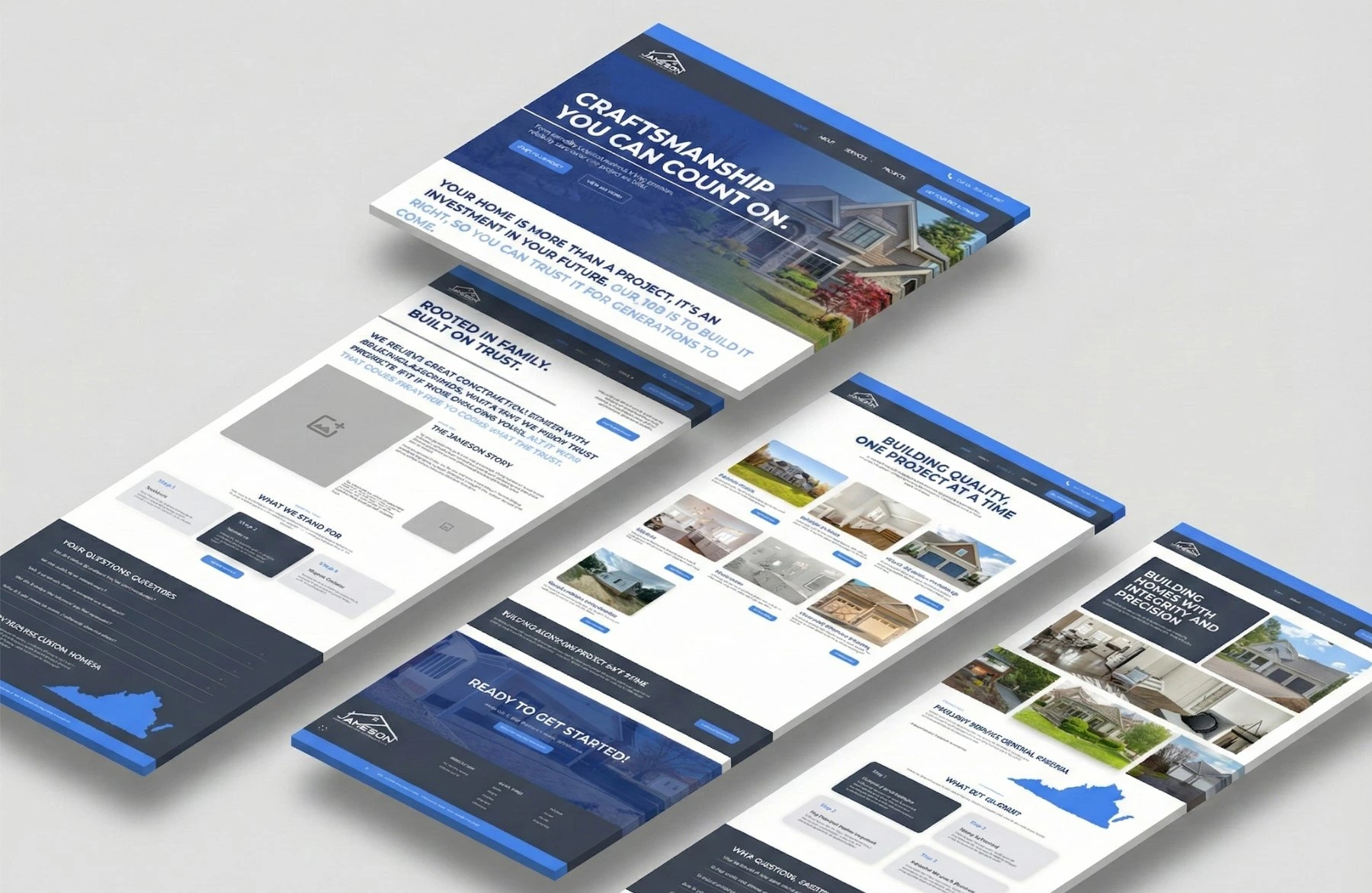
A strong website is one of the most important assets a builder can invest in. It shapes perception, explains your process, demonstrates craftsmanship, and guides a homeowner toward taking the next step. Yet most builder websites are structured like templates instead of conversion engines.

A great custom home builder website does three things extremely well. First, it shows depth. Detailed project pages, process explanations, and service breakdowns help homeowners feel grounded. Second, it creates clarity. A buyer should understand exactly what you build, what size of project you take on, and what your design philosophy is. Third, it showcases proof. The Home Improvement Research Institute found that 81 percent of homeowners research projects and service providers online before contacting anyone directly.[2] That means the quality of your visuals, testimonials, and site experience influences whether they trust you enough to start a conversation.

When your website loads quickly, presents high-end work, and clearly outlines what you do differently, you’re not just informing people; you’re positioning yourself as the safest, most competent option.

3. Use High-Intent SEO to Capture Buyers Already Planning a Build

SEO for custom home builders isn’t about vanity keywords like “custom home ideas.” It’s about ranking for location-driven, project-ready searches like:

custom home builder Charlotte
new home construction Greenville
design build firms near me

These are the searches made by people actively evaluating who they should work with — not people browsing design inspiration. I’ve seen builders generate reliable, predictable pipelines purely by owning these phrases in their markets. It takes time and consistency, but when SEO compounds, it becomes one of the highest-margin channels in the entire marketing mix.

The builders who struggle with SEO tend to focus on content that attracts dreamers instead of doers. But when you structure your content around buying intent and location relevance, traffic starts turning into real conversations.

4. Run Google Ads to Reach Buyers at the Exact Moment They’re Ready to Talk

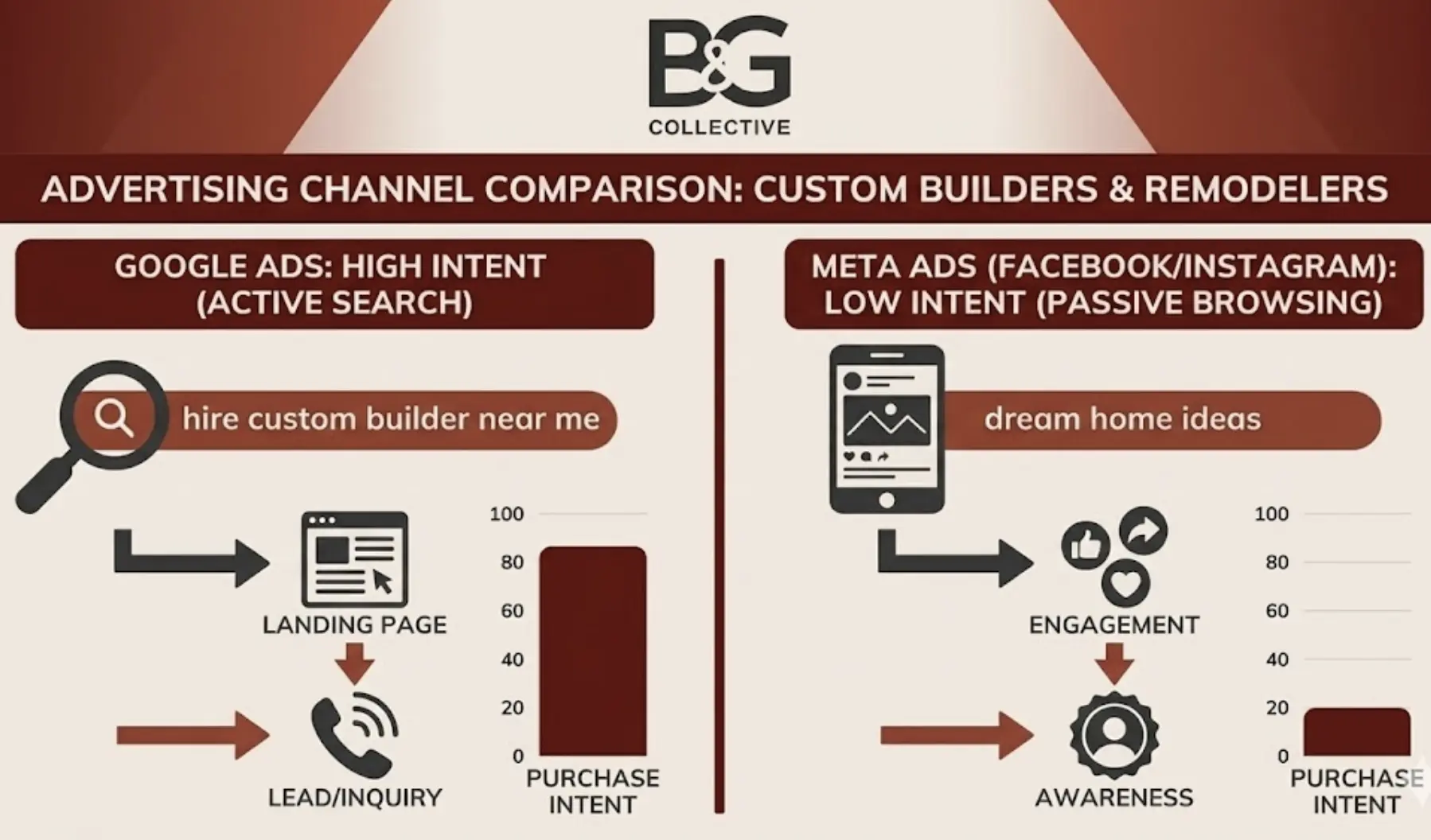
Google Ads is one of the fastest ways for custom home builders to fill the top of their pipeline because it captures demand the instant someone begins actively searching for build partners. When someone types “custom home builder near me,” they’re not exploring possibilities — they’re entering the decision stage.

The success of Google Ads hinges on precision. You have to segment campaigns by service, restrict targeting to viable build areas, structure tight keyword groups, and send traffic to pages speaking directly to that buyer’s intent. Most underperforming search campaigns fall apart because of broad targeting, weak landing pages, and a lack of clear prequalification.

When done right, Google Ads doesn’t just produce leads; it produces conversations with people who are actively planning a project, have a budget, and need guidance on next steps.

5. Use Local Services Ads to Reinforce Trust and Capture Phone-Ready Buyers

Local Services Ads (LSAs) create a fast track for credibility because the Google Screened badge acts like a third-party endorsement. For homeowners, this signals vetting, verification, and legitimacy. For builders, it creates an advantage over competitors who either haven’t bothered to activate LSAs or haven’t collected enough reviews to rank well.

LSAs reward companies with steady review volume, consistent responsiveness, and accurate business information. When these inputs are strong, you begin appearing at the very top of the local search results — above even paid search ads. For builders, this placement is powerful because it converts people who prefer speaking to someone instead of filling out forms. If your team responds quickly, LSAs can become one of the most efficient lead sources in your entire marketing system.

6. Use Project Photography and Video as Core Sales Assets, Not Just Marketing Collateral

In custom home construction, visuals do more selling than words ever will. The difference between “good enough” photos and true portfolio-level imagery often determines whether a homeowner immediately sees you as a premium builder.

I’ve watched builders transform their close rates simply by investing in professional photography and taking the time to document finished projects the right way. Drone footage, walkthrough videos, timelapses, and detailed before-and-after galleries are not extras — they’re essential tools that establish quality in a way no written description can.

When you show craftsmanship with clarity, homeowners see possibility. When you skip it, they’re forced to guess.

7. Build a Review Engine That Never Stops Running

The builders getting the highest-quality inbound leads are the ones prioritizing review volume, recency, and depth. It’s not uncommon for custom home clients to read twenty or more reviews before choosing who to contact. They’re looking for patterns, professionalism, and reassurance.

Collecting reviews isn’t just about asking; it’s about creating a system. Builders who ask immediately after the final walkthrough, follow up once or twice with a direct link, and reference the review in their wrap-up messaging see dramatically better results. Just as important is responding to reviews — especially the occasional negative ones — with professionalism. Homeowners are not judging the score; they’re judging your integrity.

8. Create Content That Attracts Serious Buyers, Not Dreamers

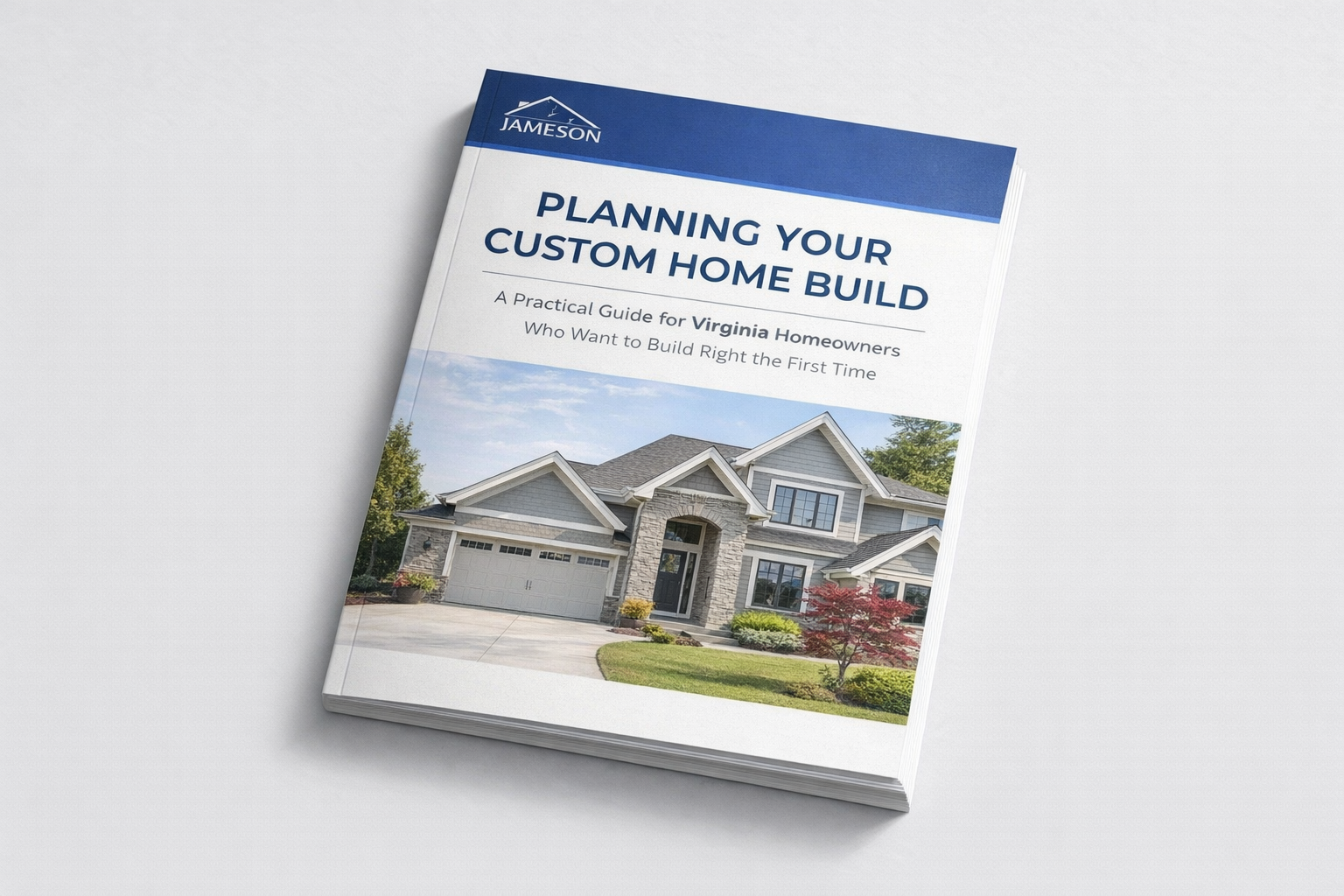
A good content strategy filters the audience. Custom home buyers want clarity around timelines, budgeting, architectural collaboration, permitting, and construction phases. When you create articles, videos, and downloadable guides that answer these questions openly, you attract people who are planning real projects — not scrolling for inspiration.

Content also plays a critical role in SEO and retargeting campaigns. When you share real projects, cost ranges, design principles, and behind-the-scenes process walkthroughs, you earn trust before the first call. The builder who educates becomes the builder who leads.

9. Use Targeted Social Media to Stay Visible During Long Sales Cycles

The decision cycle for a custom home build can stretch across months or even years. Social media keeps you present during the waiting period. I’m not talking about dance videos or viral hashtags; I’m talking about showing your work, process, progress updates, and customer stories.

Most of the value of social media for builders comes from staying top-of-mind with people who already know you, have visited your website, or contacted you previously. Remarketing ads, project spotlights, and short videos explaining how you approach builds create steady, low-cost reinforcement that pays off when the homeowner is finally ready to commit.

10. Treat Follow-Up as a Core Part of Your Marketing System

Your marketing can be flawless, but if your follow-up is slow, inconsistent, or unclear, you’ll lose deals to builders who appear more attentive. Custom home buyers often speak with multiple companies, and the builder who responds fastest and communicates the clearest next step is usually the one who earns the meeting.

The best builders use structured follow-up systems. They send immediate confirmations, outline what will happen next, share relevant resources, and follow up within a defined timeline. That consistency conveys professionalism and reduces the mental load on the buyer. When you make the experience smooth from the first touch, you build confidence that carries through the entire project.

Conclusion

Custom home builder marketing isn’t about shouting louder than your competition. It’s about engineering trust. When you build a cohesive brand, invest in strong digital foundations, use paid search strategically, collect reviews consistently, and guide homeowners through a transparent and supportive process, you stop chasing leads and start earning ideal clients.

Every strategy in this guide serves the same purpose: to make your company the safest, clearest, most compelling choice in your market.

FAQ SECTION

How long does it take for custom home builder marketing to work?

Most builders see early traction within 30–60 days through Google Ads and LSAs, with SEO compounding meaningfully after 90–180 days.

Where should I focus first if I have limited resources?

Start with your website, Google Business Profile, reviews, and a tightly targeted search campaign. These channels capture the highest-intent buyers.

Do social media ads work for custom home builders?

They work best for remarketing and reinforcing trust during longer decision cycles. Social isn’t the primary driver of new inquiries, but it strengthens conversion.

How important is project photography?

Critical. For custom home buyers, visuals carry as much weight as credentials.

Can B&G Collective run the entire marketing system for builders?

Yes. I manage strategy, paid media, SEO, review systems, content, and analytics for custom home builders who want a predictable pipeline built on real data.

FOOTNOTES

[1] National Association of Realtors. “Real Estate in a Digital Age Report.” https://www.axios.com/2023/11/13/homebuyers-online-data-report-housing-market-nar
[2] Home Improvement Research Institute (HIRI). Annual Homeowner Project Decision Study. https://hiri.org

start now

Let’s create your next win.

Let’s talk about results like these for your team.
get started
get started

services

001

Lead Gen Systems

Performance-driven campaigns that attract high-intent leads and keep your pipeline full.

002

website & Creative

Clean, conversion-focused design that builds trust and turns interest into action.

003

Brand Identity & Messaging

Strategic branding that builds credibility, aligns your voice, and supports every channel.

004

Search & Content Strategy

SEO and content built to boost visibility, drive organic traffic, and support long-term growth.

005

Growth Strategy & Consulting

Actionable, insight-led marketing plans that prioritize clarity, ROI, and momentum.

start today

Done Reading? Let’s Start Building.

Turn tactics into traction with a strategy built to perform, no guesswork, no fluff, just results.