If you build custom homes, you already know what unpredictability feels like.
Some years the phone will not stop ringing. Agents call. Architects send warm introductions. Past clients refer friends who want to “do what they did, but bigger.” Then rates move, inventory changes, or the local market cools, and suddenly the natural demand dries up. You go from turning people away to wondering where the next serious inquiry will come from.
Most custom home builders do what seems reasonable. They lean harder on relationships. They sponsor an event. They pay for a placement in a “top builders” directory. They post a few project photos on Instagram and hope something hits. Sometimes it works for a while. Often it does not.
The problem is not that marketing is broken for custom home builders. The problem is that most builders are trying to grow a high ticket, long cycle, deeply considered purchase with tools built for transactional businesses.
Custom homes are not impulse buys. Buyers research for months. They gather ideas, watch markets, talk to lenders, study floor plans, and compare builders on every visible detail long before you ever see their name in your inbox.
This guide is about building a marketing system that matches that reality. A system that brings the right buyers, not just more inquiries. The goal is not “more activity.” The goal is a pipeline you can understand, steer, and rely on.
Think of this as a playbook you can return to. When markets shift. When referrals dip. When you want control instead of hope.
Most custom builders do not start with a marketing system. They start with craftsmanship and reputation. That works at the beginning.
You complete a few projects. Word spreads in the neighborhood and among your first clients. A couple of real estate agents start bringing you their “picky” buyers. An architect or designer finds you easy to work with and begins recommending you. For a period of time, that can fill a small pipeline.
The issue is that none of that is truly under your control. If an agent changes brokerages, an architect retires, or a few past clients move away, your referral flow can slow without warning. At the same time, more builders enter your market, national brands increase their visibility, and buyers become more comfortable researching options online without talking to anyone first.
So you experiment.
You spin up a website. It may look good, but often it is slow to load and thin on the information buyers actually need. You try a little bit of everything: sponsor a local event, pay for a magazine ad, run a few Google Ads or Facebook campaigns, post some finished homes on social media. You may even hire a marketing agency that hands you reports full of clicks and impressions, yet cannot answer a simple question: how many signed builds came from this work.
Meanwhile, buyers have changed how they make decisions.
Recent research shows that a large share of buyers begin their home search online and rely heavily on digital tools to evaluate new construction. They look at builder websites, gallery photos, virtual tours, testimonials, and community details before they ever reach out. For new construction specifically, surveys from platforms such as Zillow have shown that buyers increasingly use online resources to compare builders, floor plans, and locations, long before they step inside a model home.
If your marketing is not designed for that behavior, you are almost invisible during the part of the journey that matters most.
When we build campaigns and systems for custom home builders at B&G, we start with a simple conviction: your marketing should reflect the level of thought, precision, and care that goes into your homes.
That means a few things.
First, quality of opportunity matters more than volume of leads. A handful of well-qualified, financially ready buyers who already align with your project types is far more valuable than a long list of casual browsers who vanish once numbers get real.
Second, custom builders deserve positioning that matches the value they create. You are not a commodity home provider. The families you serve are making one of the largest financial and emotional decisions of their lives. They deserve clarity. You deserve a brand that presents your work accordingly.
Third, return on investment is the only marketing metric that really counts in the long run. We care about cost per qualified planning meeting, cost per signed build, and long term profit per client. Clicks, impressions, and “engagement” only matter if they eventually translate to contracts.
Fourth, systems always outperform stunts. A consistent, testable combination of search, content, local presence, and follow up will beat any one-off campaign or seasonal spike. The builders who win control their process rather than reacting to it.
Finally, you should own your pipeline. Partners, agents, and referrals will always be valuable, but they should not be the only way work finds you. A healthy custom builder has a machine that generates its own demand, even when the external environment shifts.
That is the backbone of this guide.
Before you put another dollar into ads or redesign your website, you need a clear view of what you can afford to pay to win a build.
The math is straightforward once you commit to it.
Start with your average contract value. For many custom builders, that might be a build in the 750,000 to 1.8 million range, depending on your market. Then look at your gross margin after land (if included), materials, labor, and subs. A healthy margin for custom building often falls somewhere in the twenties as a percentage, though the exact figure is unique to your operation.
Next, understand your sales cycle. Custom builds move slowly. It is common to see three, six, even twelve months between first contact and a signed agreement. That length matters because it affects how many active opportunities you need in your pipeline at any time.
Then look at your lead progression. Out of ten inquiries that come in, how many genuinely fit your model. A buyer with no land, no clear budget, and no lender conversation is in a very different place than a buyer who has secured a lot, spoken to the bank, and has a defined range.
Finally, out of ten qualified prospects who do progress to a design or planning meeting, how many sign a contract with you. That percentage is your qualified-to-signed rate.
Once you know your average gross profit per build and your appetite for reinvesting part of that profit into marketing, you can calculate your maximum customer acquisition cost.
If, for example, your average gross profit is 200,000 and you decide that using 15 percent of that to acquire a new build is acceptable, then your maximum CAC is 30,000. If it typically takes ten qualified opportunities to land one build, then your target cost per qualified lead is around 3,000.
Those numbers may feel large at first, especially if you are used to thinking about “cheap leads.” But this is how high ticket, long cycle businesses work. When you see the full picture, search campaigns or content investments that once felt expensive suddenly become logical.
“Anyone who wants to build a house” is not a target market. It is a recipe for wasted time.
Custom home building lives at the intersection of budget, land, location, and lifestyle. The clearer you are about who you serve best, the more precisely your marketing can speak.
Ask yourself where you truly create the most value. It might be for move-up families building a forever home between certain price points. It might be for relocation buyers coming into your metro from out of state. It may be for empty nesters downsizing into highly customized spaces.
Consider where your recent best projects have come from. Look at the neighborhoods or counties where you already have a presence. Note which styles resonate with your buyers. Some builders excel in contemporary designs, others in modern farmhouse, others in traditional estates or mountain homes. These patterns matter.
You should also be honest about land. Are you primarily a build-on-your-lot firm. Do you control lots in specific communities. Do you partner with developers. A buyer with land in a target area is a very different lead from someone whose first question is “where should we buy a lot.”
All of this shapes your marketing voice. When a prospective client lands on your site or sees your ad, they should feel like you are speaking directly to their situation, not to a generic idea of “people who might want a house someday.”
Custom home buyers move through a longer and more layered decision process than a typical remodeling client, but the basic funnel still applies.
At the top of the funnel, people are dreaming. They browse Pinterest, Instagram, and design blogs. They collect images of kitchens, exteriors, staircases, and outdoor living spaces. They may not have land or financing yet, but they are forming opinions about style, scale, and what “home” should feel like for the next phase of their life.
This is where educational content and inspiration pieces help you enter the conversation early. Articles about “what it really costs to build in this county,” explainers on build vs buy, resources about designing for multi-generational living, or guides to choosing a lot in your region. Builders who publish clear, honest information earn early trust.
In the middle of the funnel, buyers move from “someday” into “we are going to do this.” They start searching more specifically. Queries shift toward “custom home builder near me,” “design build firm [city],” or “best custom home builders [region].” They compare websites, study galleries, read reviews, and quietly evaluate which builders feel serious and established.
This part of the journey is where your website, your Google Business Profile, your reviews, and your visual proof carry most of the weight. If your brand looks inconsistent, your photos are outdated, or your process is unclear, buyers move on.
At the bottom of the funnel, buyers narrow to a short list. They reach out, request consultations, and begin deeper conversations. At this stage, your response time, your intake questions, and your ability to clearly explain next steps determine how many of those inquiries become design meetings and eventually signed contracts.
The key is to understand that your marketing must support all three layers. Most builders only participate at the bottom, when buyers finally call. The opportunity lies in being present and useful much earlier.
For a custom builder, your website functions as a digital model home and design center combined. Buyers will spend more time on it than they will in any physical space you control.
If it is slow, confusing, or vague, they will assume your process is too.
A strong custom home builder website does a few things very well.
First, it explains what you actually do. That means clearly outlining whether you focus on build-on-your-lot projects, specific communities, infill in established neighborhoods, acreage builds, or some combination. Buyers should never have to guess whether they fit.
Second, it walks through your process in plain language. A dedicated “Our Process” page that describes discovery, design, selections, construction, and warranty in logical stages gives buyers confidence. When they can see the path, the project feels less intimidating.
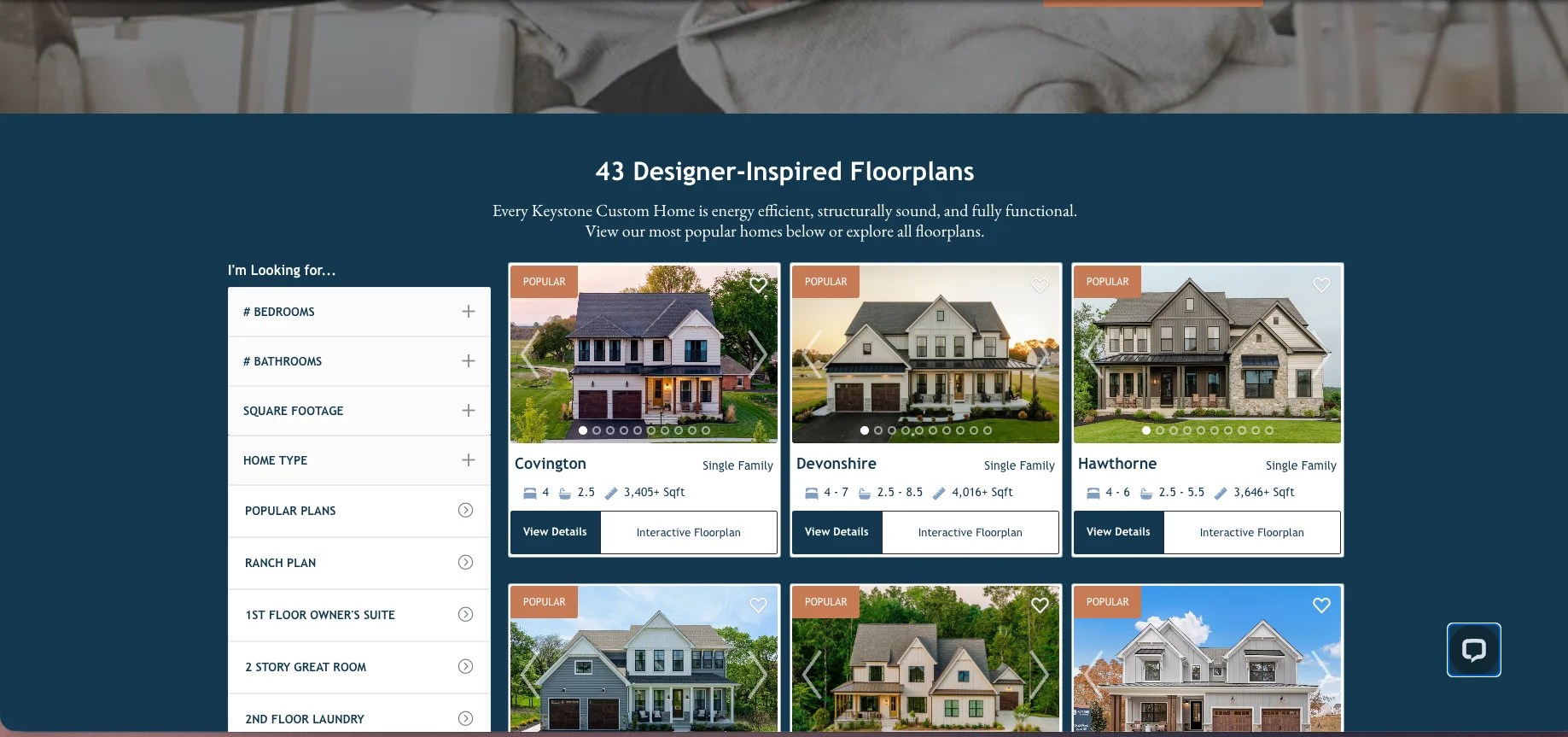
Third, it showcases your work in a way that matches how buyers actually look at homes. Projects can be grouped by style, price band, or community. Each should include thoughtful photos, basic specs, and a short story connecting the client’s goals to the finished result.
Fourth, it incorporates proof. Testimonials, case studies, association memberships, awards, and warranties signal that you are an established, accountable builder, not just a logo and a portfolio.
Finally, it makes contact simple. One primary call to action, repeated in appropriate places, works best. “Schedule a planning call” or “Request a consultation” are clearer than a general “Contact us.” Keep forms focused on what you truly need to qualify interest, and make sure the site is fast on mobile as well as desktop.
Remember, buyers are silently comparing you against other builders whose sites may be clearer or more modern. Your website is often the first impression that decides whether a conversation even starts.
When a prospective client types “custom home builder [city]” into Google, they are no longer just dreaming. They are looking for options.
Search is where intent shows up, and it remains one of the most powerful tools for custom builders when it is set up with discipline.
The most effective Google Ads strategies for custom builders focus tightly on high-intent language. Phrases like “custom home builder [city],” “design build firm [region],” “luxury home builder [city],” or “build on your lot [county]” signal that the buyer is past vague interest and is now actively researching providers.
Targeting should mirror your actual service area. It is usually a mistake to advertise across an entire state if you only build in two or three counties. Focus your spend where your team can realistically serve and where your past projects already create social proof.
Equally important is where your ads send people. Instead of sending all search traffic to your homepage, route visitors to landing pages that directly match the language in the ad. Someone who clicks an ad about building on their own lot in a specific county should land on a page that talks about that exact service, with local photos and a clear explanation of your approach.
The copy in your ads does not need to be clever. It needs to be clear. It should state who you are, where you build, and why a buyer should feel comfortable taking a next step. Mention your location, your role as a custom builder or design-build firm, and one or two trust signals such as years in business, number of completed homes, or association membership.
Under all of this sits tracking. Call tracking numbers, form tracking, and CRM integration are not technical afterthoughts. They are what allow you to see which keywords and campaigns lead to actual planning meetings and signed contracts. Without that visibility, it is impossible to know whether “Google Ads works.” With it, you can invest with confidence.
Search ads help you reach buyers who are ready to talk now. SEO and content help you be present for the buyers who are researching months before they are willing to fill out a form.
For custom home builders, the most effective organic strategy usually revolves around a handful of core elements rather than a blog filled with random topics.
Location-specific service pages that speak to “custom home builder [city]” or “build on your lot [county]” create relevance for the areas you care about. These should not be thin. They should show local projects, describe conditions unique to that area, and address questions residents actually ask.
Cost guides are consistently powerful. Buyers look for phrases like “how much does it cost to build a custom home in [area]” or “cost to build on your lot [region].” Transparent, well-structured articles on these questions build trust far more effectively than vague promises.
Process pages and educational guides demystify the journey. Explaining timelines, permitting steps, design phases, or financing considerations positions you as a guide rather than just a vendor.
Over time, this body of content compounds. It helps your site rank for the phrases buyers use during their early and middle research phases. It also gives your sales team assets they can share during conversations, which reinforces expertise.
Even in a digital-first world, local presence still matters for builders. Buyers want to know that you are real, rooted, and respected where you work.
Your Google Business Profile is a big part of that. It should reflect your correct name, address, phone number, categories, service areas, and office or model locations. It should be filled with real photos of your work, your team, and your finished homes, not just renderings.
Reviews sit at the center of trust. A steady stream of authentic, specific Google reviews from past clients carries more weight than almost any marketing claim you can make. Make it a habit to request reviews at key points. Celebrate them internally. Respond thoughtfully. Buyers read those responses.
Beyond Google, the right mix of local association listings, home builder directories, and selective real estate partnerships signal that you are integrated into the professional ecosystem, not just appearing on ads.
Visual proof ties it all together. Professional photography of finished homes, short video walkthroughs, drone footage where appropriate, and carefully chosen before-and-after stories all help a buyer picture themselves in your work. When someone can visually imagine their future home based on your portfolio, their perception of risk drops significantly.
Social platforms and email campaigns are often oversold as primary lead sources for custom builders. In reality, their strength is in support and reinforcement.
On social, focus on documenting real projects and telling real stories. Show progress. Highlight design decisions. Share small moments from selections meetings or site visits that illustrate your process. Use these platforms to retarget people who have already visited your site, clicked an ad, or downloaded a guide. That keeps you in their field of view as they continue to research.
Email works best as a nurturing tool. Once someone has raised a hand, even if they are twelve or eighteen months out, a well-timed sequence of planning resources, project highlights, and market updates can keep your firm top of mind without constant manual follow up.
The key is to see both channels as part of an ecosystem. Search introduces you to new buyers at the moment of intent. Content and SEO support their independent research. Social and email deepen the relationship over time.
Bringing the right people into your pipeline is only half of the equation. You also need a sales process that treats their interest with respect and gives them a clear path forward.
That begins with responsiveness. Even in a long sales cycle environment like custom home building, answering inquiries quickly signals competence. Many buyers contact multiple builders in the same day. The one who responds first with clarity and warmth starts ahead.
From there, you need a consistent intake structure. That might look like a short discovery call where you gather information about land, budget, timing, and desired style. The goal is not to qualify purely by money. The goal is to understand fit and stage so you can place each lead into the right next step.
Some will be ready for a structured planning meeting or design consultation. Others will still be in the research phase and may benefit from resources and periodic check-ins rather than a hard sell.
A simple CRM, even a lightweight system, makes this manageable. It lets you track who is in which stage, when you last spoke, what was discussed, and what needs to happen next. Marketing should feed this system. Sales and follow up should activate it.
Finally, treat your marketing as a system, not a set of disconnected channels.
Look at where leads originate, but do not stop there. Track how many become qualified opportunities, how many turn into planning meetings, and how many become signed build contracts. Observe which regions, messages, and traffic sources produce your highest value clients.
You might find, for example, that Google Ads in a specific county consistently yields buyers who are closer to action, while organic content draws in longer-term planners who sign down the road. You might see that certain messages around process or cost transparency resonate more than design themes alone.
When you measure at this depth, you gain the ability to adjust with intent. You can redirect budget toward the sources that create profit, refine messages that underperform, and identify parts of your process that need strengthening.
The custom builders who do this are the ones who stay steady when the market changes. They are not guessing. They are steering.
Marketing for custom home builders is not about chasing every platform or mimicking what national brands do with enormous budgets. It is about aligning your marketing with the way custom buyers actually make decisions.
Know your numbers so you understand what you can afford to invest to win a build. Define the buyers and projects that are truly right for your firm. Meet those buyers where their research begins, not just when they are finally ready to call. Use your website as a real digital model home, not just a gallery. Capture intent with search. Support the long journey with content, reviews, visuals, social, and email. Build a sales process that respects the scale of the decision. Measure what matters.
When you do that consistently, marketing stops feeling like gambling with your future. It becomes another part of the building process: thoughtful, intentional, and repeatable.
Your work shapes where people live out the next chapter of their lives. With the right system in place, your marketing can create the steady flow of right-fit projects that lets you build the kind of business you want, on purpose, not by accident.
For a few more tips on how to really dial in your online presence as a custom home builder - check out this guide where I review the top 10 things you can do with your marketing as a whole (not just digital) that will make the biggest impact in 2026- https://www.bgcollective.com/solutions-lab/top-10-custom-home-builder-marketing-strategies-that-drive-high-value-projects
The most effective marketing strategy for custom home builders is intent-driven search marketing. This means showing up where serious buyers begin their journey: Google Search, Google Business Profile, and locally relevant SEO content. Buyers researching “custom home builder near me” or “build on my lot [city]” have significantly higher intent than those casually browsing social media. When paired with a strong website and consistent follow-up, search becomes the foundation of a predictable pipeline.
Most custom builders invest between 3% and 8% of annual revenue into marketing, depending on growth goals and build volume. Because custom home projects have long timelines and high contract values, cost per qualified lead is higher than in remodeling or general contracting. A healthy starting range is $3,000–$10,000 per month in competitive markets, scaling as performance data reveals which channels deliver profitable clients.
Yes. Google Ads is one of the best-performing channels for custom builders because it targets buyers at the moment they’re actively researching builders. The key is disciplined targeting: only high-intent keywords, precise geographic constraints, structured landing pages, and real tracking. When campaigns are built correctly, the cost per qualified planning meeting becomes predictable, and builders can scale based on real ROI.
Reviews are one of the most influential trust signals in the buying process. Because buyers make decisions based on risk reduction, a builder with 40–100+ detailed Google reviews will almost always outperform a builder with just a handful. Reviews also help Google rank your business higher in the local map pack, increasing visibility without increasing ad spend.
Social media is best used for showcasing projects, building long-term brand awareness, and retargeting people who have already visited your site. It is not typically a strong source of high-intent leads on its own. Instead, think of social as a way to show your craftsmanship, share progress updates, and give buyers a window into your process. It supports the decision, rather than creating it.
A builder’s website should function as a digital model home. It must be fast, mobile-first, visually rich, and extremely clear about process, pricing realities, project types, and service areas. Buyers will spend hours comparing builder websites, and a site that looks vague, outdated, or confusing is often dismissed before a call ever occurs. High-quality photos, case studies, service pages, and a clear process overview are essential.
Yes—SEO is critical for attracting buyers early in their research. Custom home projects involve long planning periods, sometimes six to eighteen months. SEO allows builders to appear when buyers search for concepts such as cost guides, design considerations, build-on-your-lot information, or community-specific insights. Over time, a builder with a strong SEO presence becomes a default resource in the local market.
Paid search (Google Ads) can generate qualified inquiries within days or weeks. SEO and content strategies typically take three to six months to gain traction. Social proof and reviews build momentum gradually. The biggest variable is sales cycle: many buyers begin researching months before they’re ready to meet. The goal is to be visible at every step so that when buyers finally raise their hand, you’re already the builder they trust.
Most custom home builders benefit from agency support because the complexity of search advertising, tracking, SEO, and high-ticket funnel management requires specialization. The right agency will focus on quality over volume, ROI over vanity metrics, and systems rather than one-off campaigns. However, builders should avoid agencies that promise cheap leads or rely heavily on social media as the primary engine.
B&G Collective builds complete marketing systems for custom home builders. Not just ads. Not just websites. A full ecosystem: search-driven demand capture, content strategy, local visibility, review growth, landing pages that convert, and CRM-integrated tracking so builders see which marketing efforts lead to signed contracts. The goal is simple: help builders attract better clients, eliminate waste, and create a predictable flow of profitable projects.
Turn tactics into traction with a strategy built to perform, no guesswork, no fluff, just results.