the solution

Remodeling Marketing: The System Behind Predictable Growth

Most remodeling marketing advice is a list of tactics. Run Google Ads. Post on social media. Build a website. But tactics without a system produce unpredictable results. Here’s how remodelers doing $2M+ revenue build a marketing system that works, and why the system has exactly three parts.

Adrian Garcia

Ad Strategist
Last Updated:
March 31, 2026
8-10 min read

Key Takeaways:

  • Remodeling marketing is not a single channel. It’s a connected system with three parts: Google Ads to capture demand, brand trust to convert the click, and SEO to compound authority over time. Remove any one part and the other two underperform.
  • Homeowner spending on remodeling is projected to reach $522 billion by end of 2026, but competition has intensified — the number of remodeling firms has nearly doubled in 25 years. Marketing efficiency matters more than ever.
  • The remodelers who grow predictably measure cost per booked project, not cost per lead. A $300 lead that closes into a $65,000 kitchen is cheap. A $40 shared lead that never converts is expensive.
  • Brand is the most underrated part of the system. Two identical ad clicks produce different outcomes depending on whether the homeowner lands on a page with stock photography or a page with real projects, visible reviews, and a Discovery Questionnaire.
  • The system compounds. Google Ads costs the same every month. SEO produces leads at zero marginal cost once ranked. Brand builds trust that makes every channel convert better. After 12 months, the remodelers running all three have a declining cost per lead curve.

Why Is Remodeling Marketing Different from General Contractor Marketing?

Homeowner spending on remodeling improvements is projected to reach $522 billion by the end of 2026, with year-over-year growth of roughly 2–3%.¹ The demand is real. But so is the competition. The number of remodeling companies in the U.S. has grown from fewer than 69,000 in 2000 to more than 128,000 in 2025 — remodelers now represent over 56% of all residential building construction firms.²

More contractors chasing the same homeowners means the quality of your marketing system determines whether you win or lose. And remodeling marketing operates under constraints that general contractor marketing does not.

A remodeling project is a considered purchase, not an impulse buy. The homeowner planning a $60,000 kitchen or a $40,000 bathroom spends 90 to 180 days researching, comparing, and evaluating before they pick up the phone. They browse Houzz and Pinterest for weeks. They read Google reviews. They visit three to five contractor websites. By the time they reach out, they’ve already built a mental shortlist — and the remodelers who looked generic, outdated, or disorganized online didn’t make it.

That’s why a “run some ads and hope the phone rings” approach doesn’t work for remodelers. The homeowner who will spend $75,000 with you needs to trust you before the first conversation. That trust has to be built across multiple touchpoints — your ad, your landing page, your Google Business Profile, your reviews, your project photography, and your intake process. A system builds that trust. A single channel cannot.

The System Framing
Remodeling marketing is not ads OR brand OR content. It’s ads AND brand AND content working together. The ads bring the click. The brand converts the click. The content compounds authority over time. Most agencies sell remodelers one piece. The remodelers growing predictably at $2M+ run all three.


What Are the Three Parts of a Remodeling Marketing System?

The system has three parts. Each one serves a distinct function, and removing any one part degrades the performance of the other two.

Part 1: Google Ads — The Demand-Capture Engine

Google Ads captures homeowners at the moment of highest intent. When someone searches “kitchen remodel contractor near me” or “bathroom renovation [city],” they are actively evaluating who to call. That’s a buyer, not a browser. No other channel captures this level of intent at this moment in the decision process.

Across the remodeling accounts we manage, realistic 2026 benchmarks:

  • $8–$18 cost per click for kitchen and bathroom remodeling terms in most U.S. markets.
  • $150–$400 cost per lead depending on market size, service type, and landing page quality.
  • 15–25% landing page conversion rate when traffic goes to a service-specific landing page, not a homepage.
  • 25–40% lead-to-booked-project rate for design-build remodelers with strong brand signals and fast follow-up.

The remodelers paying more than these ranges almost always have one of three problems: broad keyword targeting that attracts DIY searchers, landing pages that try to sell every service at once, or no conversion tracking so Google’s algorithm never learns what a real lead looks like.

Full Google Ads strategy for remodelers bgcollective.com/solutions-lab/google-ads-for-remodelers-wins

Kitchen remodeling marketing systemhttps://www.bgcollective.com/solutions-lab/solutions-lab-kitchen-remodeling-marketing

Bathroom remodeling marketing systemhttps://www.bgcollective.com/solutions-lab/bathroom-remodeling-marketing-why-your-leads-are-too-small

Part 2: Brand Trust — The Conversion Layer

This is the part of remodeling marketing that most agencies skip. They build the ads, they drive the clicks, and then they wonder why half the traffic bounces without converting. The answer is almost always brand.

When a homeowner clicks your ad and lands on your page, they make a decision in 8–15 seconds: does this look like a company I’d trust with a $60,000 project? If your page has stock photography, a generic “Free Estimate” button, and a list of twelve services — they leave. If your page has real project photos, visible Google reviews, a clear process timeline, and a Discovery Questionnaire that signals you’re selective about who you work with — they fill out the form.

Same ad. Same click. Same $15 cost per click. Completely different outcome. The variable is brand.

This is what we call authority branding — the framework where your brand does the selling before the first conversation. For remodelers specifically, authority branding means your website, landing pages, Google Business Profile, and social presence all communicate: we’ve done this before, we know what we’re doing, and we’re organized enough to handle your project. A remodeler whose brand communicates that doesn’t need to compete on price. The brand already filtered out the price shoppers.

How brand authority filters leadsbgcollective.com/solutions-lab/remodeling-marketing-agency-insights-brand-authority-in-2026

Landing page elements that convert bgcollective.com/solutions-lab/remodeler-landing-pages-for-google-ads-the-3-non-negotiable-elements-for-15-conversion

Friction as a Feature
Replacing “Get a Free Estimate” with a Discovery Questionnaire feels counterintuitive. You’re adding steps. But those steps filter out tire-kickers and attract homeowners who are serious, organized, and ready to invest. Fewer leads, dramatically higher close rates and average project values.

Part 3: SEO & Content — The Compounding Asset

Google Ads gets you leads the day you turn it on. But the cost stays flat — you pay every month to maintain the flow. SEO delivers nothing for months, then starts producing leads at effectively zero marginal cost. The system that combines both produces a declining cost per lead curve over time.

SEO for remodelers means ranking for the searches homeowners make during their 90–180 day planning window: “kitchen remodel cost 2026,” “how to choose a remodeling contractor,” “bathroom renovation timeline.” These are research-stage queries. The homeowner isn’t ready to call yet. But when your content is the one that answered their question, you’re on the shortlist when they are.

Remodelers who invest in both Google Ads and SEO typically see their blended cost per lead drop 20–30% within six to nine months. The organic traffic picks up leads that would have required ad spend. And the brand familiarity built by the content makes paid clicks convert at higher rates — a homeowner who read your cost guide last month and then sees your Google Ad today is far more likely to click and convert than a cold searcher seeing you for the first time.

Google Ads budget framework for contractors bgcollective.com/solutions-lab/contractor-google-ads-budget

Remodeler Google Ads benchmarks 2026 bgcollective.com/solutions-lab/google-ads-remodeler-statistics-2026

The Compounding Effect
A Google Ads campaign delivers leads immediately but costs the same every month. SEO delivers nothing for months, then produces leads at zero marginal cost. After 12 months of running both, the remodelers in our portfolio have a cost per lead that’s 20–30% lower than when they started — and declining. That’s what predictable growth actually looks like.

What Does Remodeling Marketing Cost Per Booked Project?

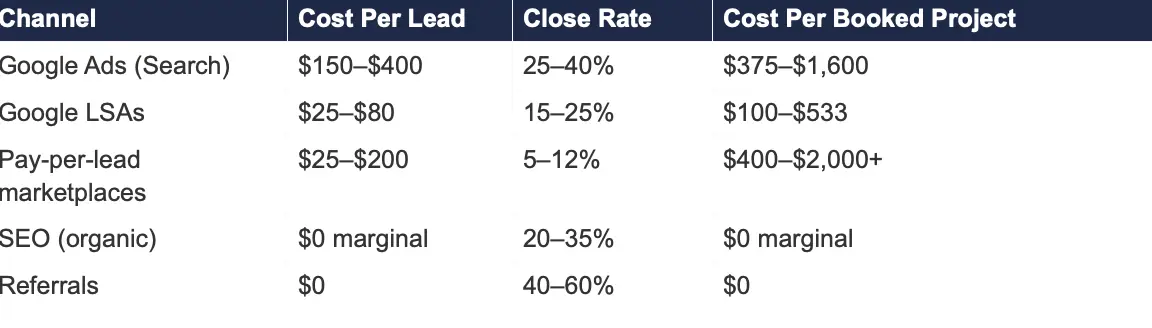
Cost per lead tells you nothing without the close rate. Here are the benchmarks across the major channels, based on data from campaigns we manage and national industry sources:

Two things stand out. First, referrals have the best economics but they’re unpredictable — you cannot scale a referral-based business to $5M. Second, the “cheapest” leads from pay-per-lead marketplaces are often the most expensive per booked project because close rates of 5–12% on shared leads destroy the math.

The remodelers growing at $2M+ revenue combine Google Ads as the demand-capture engine, SEO as the compounding authority play, LSAs as a trust-building supplement, and a brand that converts at every touchpoint. Remove any one piece and the others underperform.

Full remodeling lead generation system → bgcollective.com/solutions-lab/remodeling-leads

Cost Per Booked Project Is the Only Metric That Matters
If your marketing partner reports on cost per lead and you don’t know your close rate, you’re making decisions with half the data. A $75 marketplace lead with a 5% close rate costs $1,500 per booked project. A $300 Google Ads lead with a 35% close rate costs $857. The “expensive” lead is cheaper by almost half. Always do the math to the booked project.

How Does Your Google Business Profile Amplify Everything?

Your Google Business Profile is not a separate channel from your ads. It’s the credibility check that happens between the ad click and the conversion.

Across the remodeling accounts we manage, contractors with complete, active GBPs — 50+ reviews, 4.5+ star rating, recent project photos, weekly posts — see 50–60% better performance on Google Ads campaigns than those with thin or neglected profiles. Same ad spend, same keywords, same landing pages. The variable is what the homeowner finds when they Google your company name before filling out the form.

For remodelers: upload project photos monthly, organized by service type. Post weekly about current or recently completed projects. Respond to every review within 24 hours. Your GBP reinforces every other part of the system — it makes your ads convert better, it strengthens your LSA ranking, and it gives your SEO content a local trust signal that compounds over time.

LSA lead credits and the new credit system bgcollective.com/solutions-lab/dispute-bad-leads-local-services-ads

Build a Remodeling Marketing System That Grows With You

If you’re spending money on one marketing channel and wondering why the results are inconsistent, the answer isn’t a better channel. It’s a system.


At B&G Growth Marketing, we build remodeling marketing systems for design-build remodelers and custom home builders doing $2M+ in revenue. Google Ads, SEO, landing pages, brand, and tracking — all connected, all measured by cost per booked project, not vanity metrics. If you’re ready to stop guessing and start growing predictably, schedule a consultation.

FAQ: Remodeling Marketing

What is remodeling marketing?

Remodeling marketing is the complete system a remodeling business uses to attract, qualify, and convert homeowners into booked projects. It includes Google Ads for demand capture, brand trust for conversion, and SEO for compounding organic authority. The most effective remodeling marketing treats these as one connected system, not separate tactics.

How much should a remodeler spend on marketing?

A common benchmark for remodelers doing $2M+ revenue is 5–10% of revenue allocated to marketing. For Google Ads specifically, $3,000–$5,000 per month is a reasonable starting budget that produces 10–25 qualified leads in most markets. Add SEO and brand investments for the full system.

What is the best marketing channel for remodelers?

Google Ads is the fastest and most controllable channel for generating qualified remodeling leads. But no single channel is “best” in isolation. The remodelers with the strongest pipelines combine Google Ads, SEO, LSAs, and a brand that converts at every touchpoint. Each channel amplifies the others.

How do I get more remodeling leads?

Run service-specific Google Ads campaigns with dedicated landing pages for each service line (kitchens, bathrooms, additions). Supplement with LSAs for trust-based visibility. Invest in SEO content targeting planning-stage queries. And ensure your brand — website, photography, reviews, intake process — converts the traffic you’re paying for.

What is a good cost per lead for remodeling?

For remodelers targeting $50K+ projects, $150–$400 per lead through Google Ads is a healthy range. Below $100 typically indicates a campaign attracting smaller projects or DIY searchers. The critical metric is cost per booked project, not cost per lead — a high-CPL channel with a strong close rate often produces cheaper booked projects than a low-CPL channel with a weak close rate.

Why do my remodeling leads keep ghosting after the estimate?

Low close rates on paid leads usually indicate a brand or intake process problem, not a lead quality problem. If your website looks generic, your follow-up is slow, or your estimate process doesn’t build trust, even qualified homeowners will compare you against remodelers whose marketing did a better job positioning them as the expert.

How long does it take to build a remodeling marketing system?

Google Ads produces leads within 7–14 days of launch. Campaign optimization takes 6–8 weeks. SEO takes 6–12 months for consistent organic traffic. A fully built system combining ads, SEO, brand, and tracking typically reaches predictable monthly lead flow within 90 days.

Does my Google Business Profile affect my ad performance?

Yes, significantly. Contractors with active GBPs — 50+ reviews, 4.5+ stars, recent project photos — see 50–60% better Google Ads performance across accounts we manage. Homeowners check your GBP before converting, and what they find either confirms or destroys the trust your ad started building.

What is authority branding for remodelers?

Authority branding is the B&G framework for building brand trust that does the selling before the first conversation. It means your website, landing pages, GBP, and social presence all signal: this company is experienced, organized, and does work at the level I’m looking for. When authority branding is strong, ads convert better, close rates increase, and average project values rise.

Google Ads vs SEO for remodeling: which should I start with?

Start with Google Ads for immediate lead flow, then add SEO for compounding returns. Ads get you leads this month. SEO takes months to build but produces leads at zero marginal cost. The remodelers with the strongest pipelines run both as parts of one system.

Sources

¹ Joint Center for Housing Studies, Harvard University. "Remodeling Growth Set to Downshift in Late 2026." Leading Indicator of Remodeling Activity (LIRA), January 2026. https://www.jchs.harvard.edu/blog/remodeling-growth-set-downshift-late-2026

² National Association of Home Builders (NAHB). "NAHB Expects Remodeling Growth in 2026 and Beyond" and "Remodeling Gaining Larger Share of Residential Construction Market." NAHB, February & November 2025. https://www.nahb.org/news-and-economics/press-releases/2026/02/nahb-expects-remodeling-growth-2026

start now

Let’s create your next win.

Let’s talk about results like these for your team.
get started
get started

services

001

Lead Gen Systems

Performance-driven campaigns that attract high-intent leads and keep your pipeline full.

002

website & Creative

Clean, conversion-focused design that builds trust and turns interest into action.

003

Brand Identity & Messaging

Strategic branding that builds credibility, aligns your voice, and supports every channel.

004

Search & Content Strategy

SEO and content built to boost visibility, drive organic traffic, and support long-term growth.

005

Growth Strategy & Consulting

Actionable, insight-led marketing plans that prioritize clarity, ROI, and momentum.

Written By Adrian Garcia

Adrian Garcia is a growth marketing strategist and agency founder specializing in remodelers, design-build firms, and custom home builders. He has managed over $65M in digital advertising spend across the residential construction industry.

Related articles

start today

Done Reading? Let’s Start Building.

Turn tactics into traction with a strategy built to perform, no guesswork, no fluff, just results.