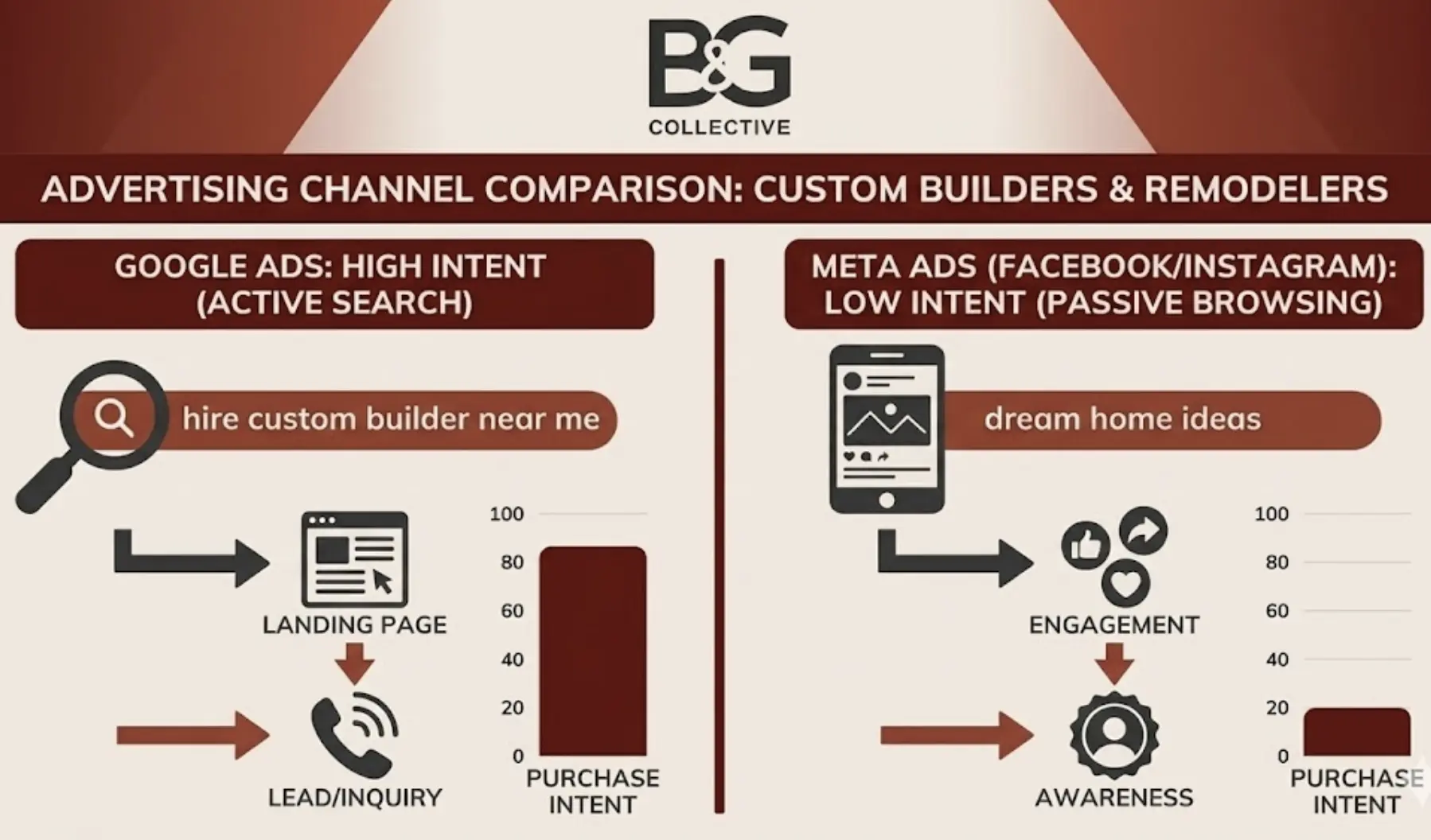
Phase 1: Capture Existing Demand (Google Ads)
This is the foundation. Before you try to convince strangers that they should want a renovation (creating demand), you must first capture the people who already want one.
There are people in your service area right now searching for exactly what you do.
- "Modern farmhouse builder [City Name]"
- "Cost of kitchen remodel 2025"
- "Design-build firms near me"
These are "money keywords." According to recent data, 93% of online experiences begin with a search engine [1]. If you are not there to answer that search, you are invisible.
The beauty of Google Ads is the control. We can target specific zip codes (down to the neighborhood level). We can bid higher on "luxury" terms and exclude "cheap" or "affordable" terms to filter out tire-kickers.
Is it expensive? Yes. In competitive markets, you might pay $15 or $20 a click. But remember the intent. A click from someone searching "hire custom builder" is worth 100x more than a "like" from someone scrolling Instagram at 2 a.m.
For the full Google Ads playbook, see how remodelers win with Google Ads.
Phase 2: The "Bridge" (Retargeting)
Once you are driving traffic from Google, you will notice something painful: 95% of them won't contact you on the first visit. This is normal. Building a custom home is a massive financial decision, not an impulse buy.
This is where we introduce the second layer. We install a tracking pixel on your site. Now, when that serious prospect leaves your site to check Facebook or Instagram, your brand follows them.
This is the only time I recommend Social Media in the early stages. We aren't using it to find new people; we are using it to stay in front of the interested people we found on Google.
Phase 3: Demand Generation (Social & SEO)
Only after you are capturing the high-intent traffic (Phase 1) and retargeting the bounces (Phase 2) should you spend money on "cold" social media ads.
Instagram is great for brand awareness. It builds trust. It validates your quality. But it is passive. If you have a hole in your schedule for Q2, a pretty Instagram reel won't fix it. Google Ads will.
The "Vanity Metric" Trap
The reason so many builders get this wrong is that Google Ads is boring. It's text. It's spreadsheets. It doesn't give you the dopamine hit of seeing 500 likes on a photo.
I challenge you to look at your bank account, not your notification center.
I worked with a design-build firm in Texas that was obsessed with Houzz and Instagram. They had thousands of followers but erratic revenue. We shifted 70% of their budget to Google Search campaigns targeting specific architectural styles they specialized in. Their follower count stopped growing. Their "likes" plummeted.
But their qualified leads increased by 40% in ninety days.
Why? Because we stopped shouting at a crowd and started whispering to the people who were already looking for us.
How to Allocate Your 2025 Budget
If you are sitting down to plan your spend, here is the playbook:
- Fund the Search First: Allocate enough budget to capture the majority of search traffic for your core services. If the search volume exists, buy it.
- Check the "Impression Share": In your Google Ads dashboard, look at a metric called "Search Impression Share." If this is below 80%, do not spend a dime on Facebook or Instagram cold ads. You are leaving high-intent money on the table.
- Add the Visuals Later: Once you own the search results, then use your surplus budget to build that beautiful brand on social media.
Marketing is about timing. Social media catches them when they are dreaming. Google catches them when they are deciding.
As a business owner, which client do you want to talk to?
.webp)